2026-11-11
Eyelid Revision Surgery: How to Avoid Another Failure
A guide to eyelid revision surgery covering why it is harder than the first procedure, the ideal timing (6+ months later), common revision cases, and key points for a lasting result.


Eyelid Revision Surgery: How to Avoid Another Failure

Hello, this is Four Seasons Plastic Surgery Clinic. ^^
Many people struggle with worry when their first eyelid surgery doesn't give them the result they wanted, or when their lid line changes over time.
The eyes play a huge role in shaping your overall impression. Because they are such an important feature, a failed first surgery can be more than a cosmetic disappointment. It can also cause significant emotional stress.
However, eyelid revision surgery is much more difficult than the first procedure. The skin, muscle, and fat in the eyelid have already been damaged once, and adhesions have formed during the initial surgery. For this reason, simply re-creating the line rarely produces a satisfying result.
To avoid another failure in eyelid revision surgery, the cause of the previous failure must be analyzed accurately. A personalized plan must come first, one that takes into account the current structure of your eyes, the amount of spare skin, and the strength of your eye muscles.
There are many reasons people decide to undergo eyelid revision surgery.
What Are the Common Causes That Lead to Double Eyelid Revision Surgery?
Revision may be worth considering in cases such as: sausage eyes caused by a crease set too high; a weakened fixation that makes the line blurry or causes the double eyelid to loosen; a bumpy scar along the incision line that bothers you; asymmetry, where the height or depth of the two lines differs; excessive skin removal during canthoplasty (eye-corner opening) that leaves prominent red scars or a visible epicanthal fold; and a need for eye shape correction to address a sleepy look caused by weak eye-opening muscle strength.

Before planning a successful revision, it helps to systematically check your eyes in a mirror.
Q2. What is the current condition of your eyelid skin and internal tissues?
When planning revision surgery, it is essential to carefully evaluate the amount of excess skin that can be removed, the thickness of the eyelid skin, and how much muscle and fat were removed during the first surgery. If there isn't enough spare skin, a two-line technique that releases the adhesions and creates a new line may be more suitable than a new incision. That is why it is important to accurately assess your skin condition.
Q3. What is your ideal double eyelid line?
Think about which line best suits the proportions of your features and the shape of your eyes. Options include a natural inline that follows the lid, the currently popular in-and-out line, a stylish and refined semi-outline, or an outline that makes your features look more defined.
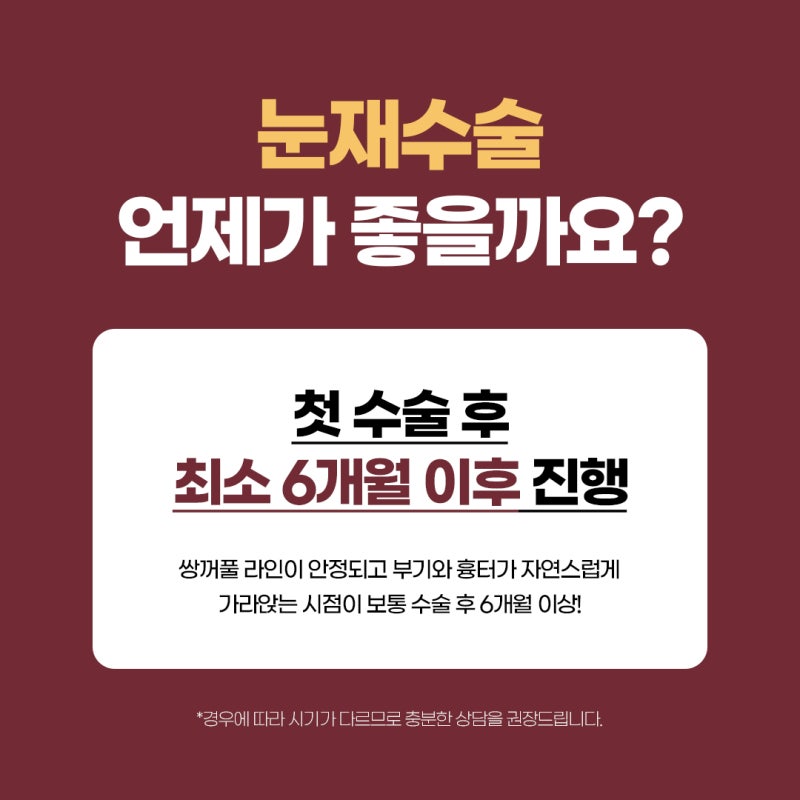
If you are unhappy with the results of your first surgery, you will naturally want to correct them as soon as possible. So when is the right time for revision surgery?
In general, we recommend scheduling eyelid revision surgery at least six months after your first procedure. The damaged eyelid skin and scar tissue need time to heal, and internal tissue firmness and swelling need time to subside so the line can stabilize. This usually takes more than six months.
If you attempt revision while the tissue is still hardened, wound healing can be slow and additional scarring may occur.
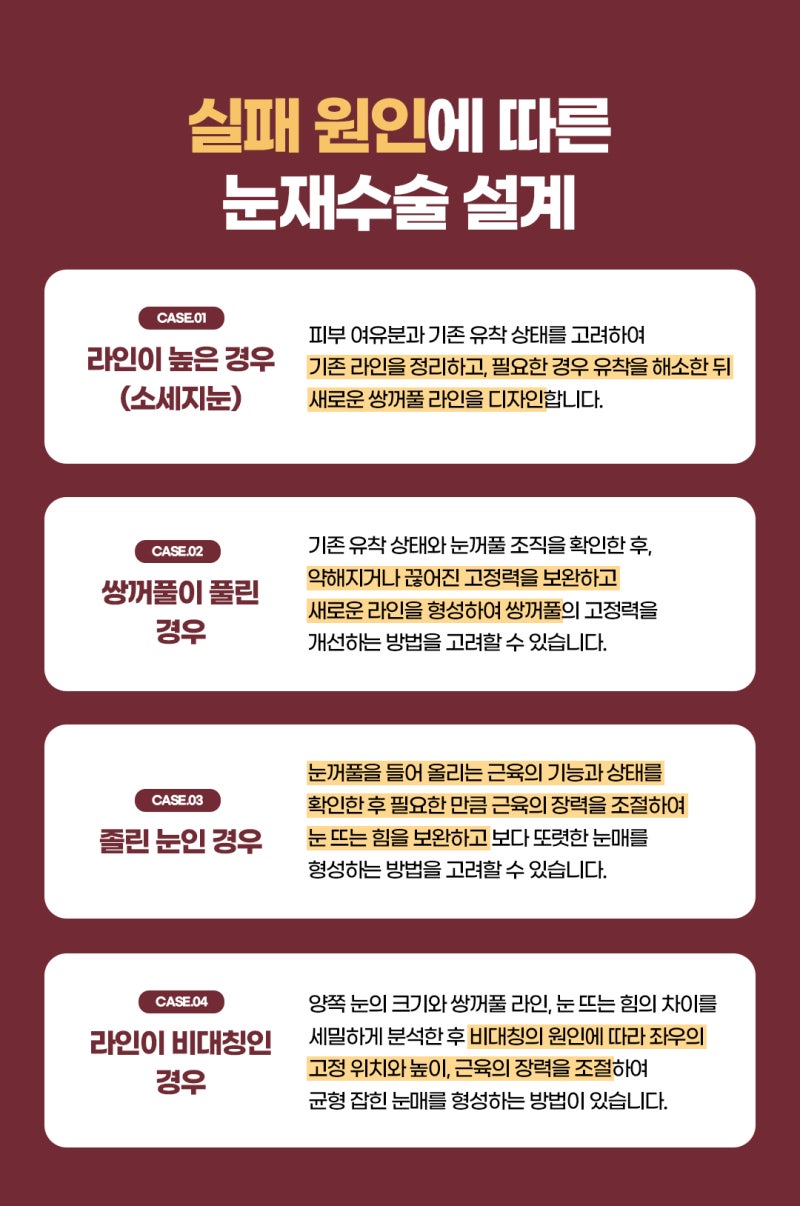
Eyelid revision surgery begins with a precise, multi-angle analysis of why the first surgery failed. It is important to pinpoint these problems accurately and design the revision to suit the structure of your eyes.
There are many different cases, but here are some revision scenarios that apply to many patients.
CASE 01. High Line (Sausage Eyes)
We carefully analyze the amount of spare skin and the adhesion condition left by the previous surgery. After gently releasing the tightly bound adhesions in the existing line, we remove unnecessary tissue and design a new double eyelid line at the desired height.
CASE 02. Loosened Double Eyelid
We check why the tissue fixed during the first surgery came loose or lost its holding strength. We reinforce the inner structure of the eyelid to restore the weakened fixation, then form a clear line with secure sutures that will not easily loosen.
CASE 03. Weak Eye-Opening Strength or a Sleepy Appearance
Simply lifting the eyelid skin may still leave the eyes looking dull. We assess the tension of the levator muscle that lifts the upper eyelid, then finely adjust muscle strength to create bright, lively eyes.

What are some key points to keep in mind for eyelid revision surgery?
POINT 01 A Customized Double Eyelid Line Suited to Your Eyes
Rather than simply following the latest trends, we design a harmonious line that suits your eye structure, how much of your iris is exposed, and the balance of your facial features.
POINT 02 Firm Fixation and Enhanced Eye-Opening Strength
Beyond simply creating a line, we strengthen the muscles that open your eyes and use appropriate fixation to create eyes that look clear and feel functionally comfortable.
POINT 03 Removing Existing Scars Through Careful Dissection
We meticulously dissect the bumpy scar tissue left by the previous surgery to minimize it, smooth the skin surface, and create a clean line.
POINT 04 Fat Redistribution to Prevent Extra Folds
To prevent side effects such as eyelid hollowing or extra folds that can appear over time after surgery, we redistribute the internal fat appropriately to support a stable recovery.
There are many reasons why people decide to undergo eyelid revision surgery. Because each person's eye concerns and conditions are unique, every case calls for a precise approach tailored to it. For this reason, rather than rushing into a decision, it is important to carefully review everything, from identifying the cause and choosing the timing to planning the surgery, before deciding.
If you have any questions, feel free to message us on Naver TalkTalk!
Frequently Asked Questions
When is the best time to have eyelid revision surgery?
We generally recommend scheduling revision surgery at least six months after your first procedure. Scar tissue needs time to heal and swelling needs time to subside before the line can settle, which usually takes more than six months.
In what cases should you consider double eyelid revision surgery?
There are many reasons to consider revision, including sausage eyes, a loosened double eyelid, scarring, asymmetry, and the need for eye shape correction. Cases where the fixation has weakened and the line has blurred, or where the scar is prominent after canthoplasty, are also included.
Why is eyelid revision surgery harder than the first surgery?
The first surgery damages the internal skin, muscle, and fat of the eyelid, and adhesions form during the procedure. This makes revision much more difficult, which is why simply re-creating the line rarely produces a satisfying result.
What should you check before eyelid revision surgery?
First, an individualized plan is needed that analyzes the cause of the previous failure and considers the current structure of your eyes, the amount of spare skin, and your muscle strength. It also helps to check your eyes in a mirror and think about the line and eye condition you want.
How is the new double eyelid line decided for revision surgery?
It is important to design a line that suits your individual eye structure, how much of your iris is exposed, and the balance of your facial features. Consider which line fits your eyes best: a natural inline, the popular in-and-out line, a semi-outline, or an outline.
How are scars handled during revision surgery?
The key is to carefully dissect the bumpy scar tissue from the previous surgery to minimize it and smooth the skin surface. This process helps create a clean line.