2025-10-02
Restore a Youthful Look with Customized Lifting
As we age, skin loses elasticity and sags, leading to wrinkles. Customized lifting treatments can restore a firm, youthful appearance by addressing various layers of the face.


Restore a Youthful Look with Customized Lifting

Among the skin changes everyone experiences as they age,
the most prominent are
facial wrinkles caused by loss of elasticity and sagging.
The face is composed of multiple layers,
and a harmonious balance of skin, subcutaneous fat, muscles, and ligaments
is essential to maintain a youthful and firm appearance.
However, over time,
collagen and elastin decrease,
fat shifts downwards or diminishes,
and muscles and ligaments weaken,
causing the facial lines to collapse
and wrinkles to deepen.
External factors like UV rays and lifestyle habits further contribute to this,
leading to a loss of facial contour and elasticity.
This can make one look more tired
and older than their actual age.
So, specifically, at what age does
aging begin, and what changes occur
at different age groups?
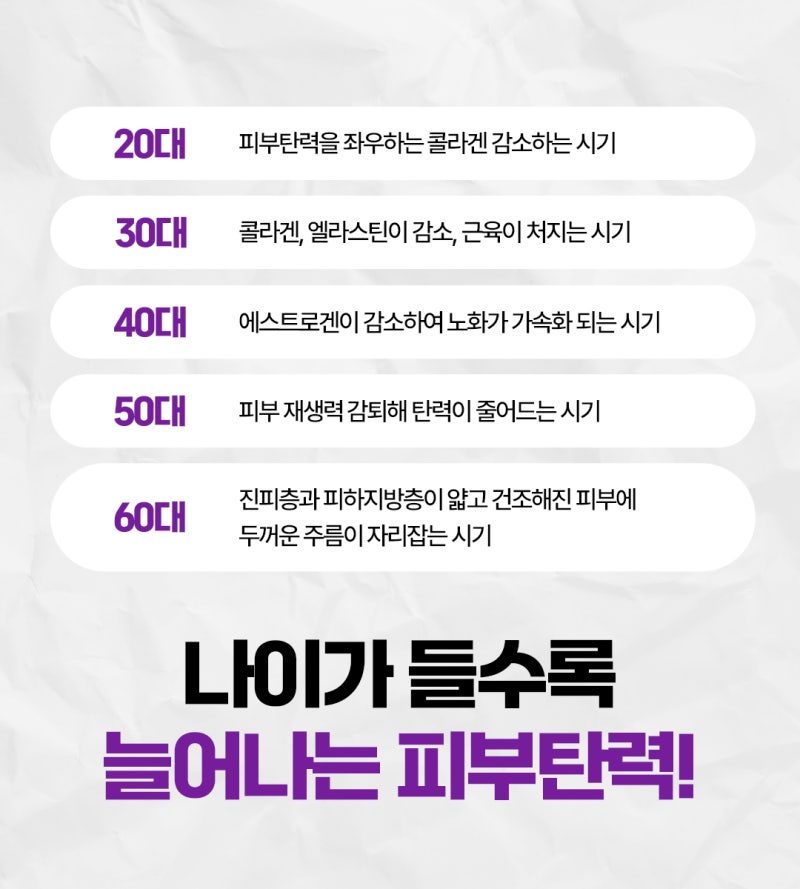
In their 20s, collagen, which determines skin elasticity, begins to decrease.
In their 30s, collagen and elastin decrease, and muscles start to sag.
In their 40s, estrogen levels decline,
accelerating the aging process.
In their 50s, skin regeneration capacity diminishes, reducing elasticity.
In their 60s, the dermal and subcutaneous fat layers become thinner
and drier, leading to the formation of deep wrinkles.
Lifting is not a procedure to be considered
only when the skin has already sagged.
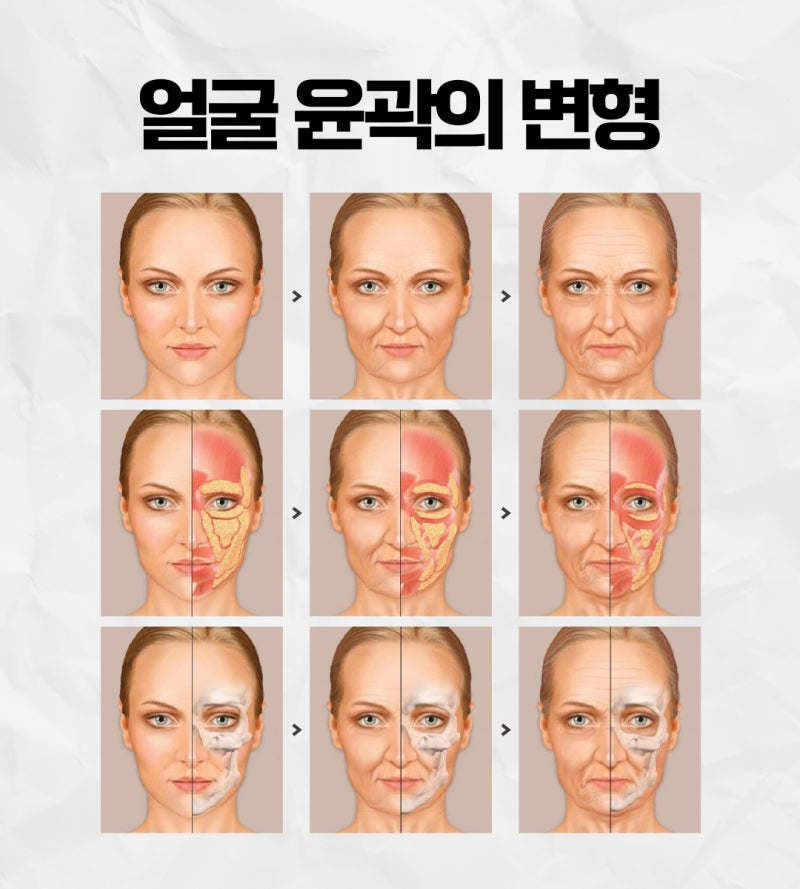
In reality, aging doesn't just occur on the skin's surface;
it simultaneously progresses in various underlying structures of the skin.
Along with the loss of skin elasticity,
muscles sag downwards, fat diminishes or
changes position, and even bone thickness
decreases, all of which are part of the aging process.
Not only visible wrinkles, but also the forehead and eyebrows
gradually descend, causing the eyelids to cover the pupils,
the mid-face to lengthen, deepening nasolabial folds,
and the jawline to collapse.
Neck wrinkles also become more pronounced,
altering the overall facial contour.
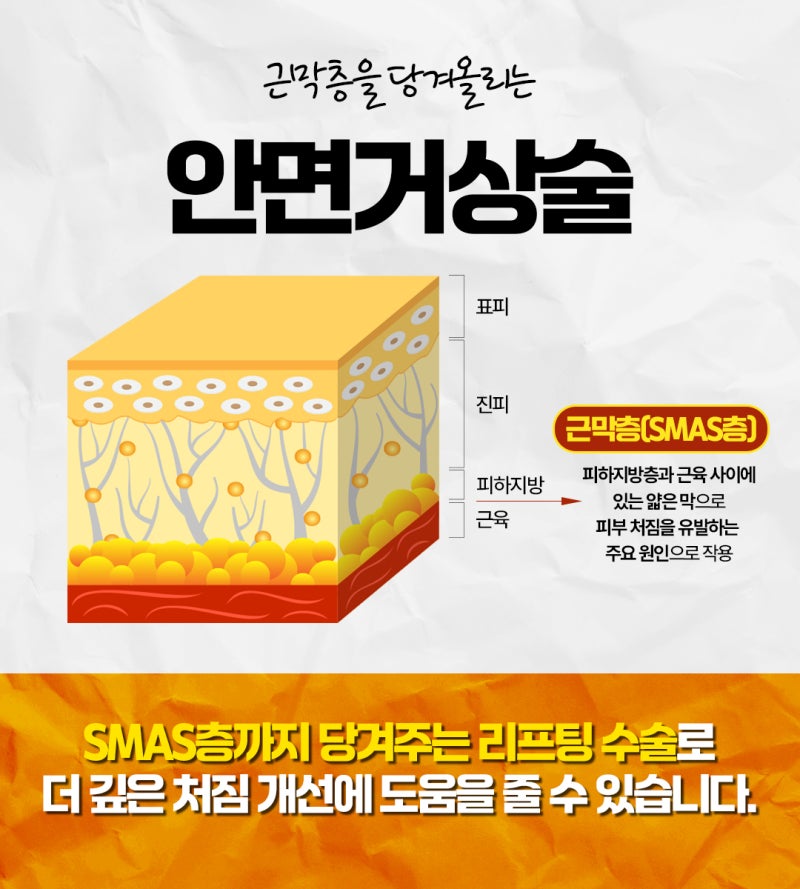
There are many types of lifting procedures available in Busan.
These include non-incisional methods like lifting lasers or Busan thread lifts,
and surgical methods such as facelifts and forehead lifts.
One of the options to improve these changes
is a facelift.
A facelift is a surgery that lifts the entire face,
tightening and fixing the sagging skin along with the SMAS layer (superficial musculoaponeurotic system),
thereby offering more fundamental improvement.
If only the superficial skin is pulled,
sagging may recur over time, but
a method that also addresses the SMAS layer provides longer-lasting effects
and helps restore the natural curves of the face.
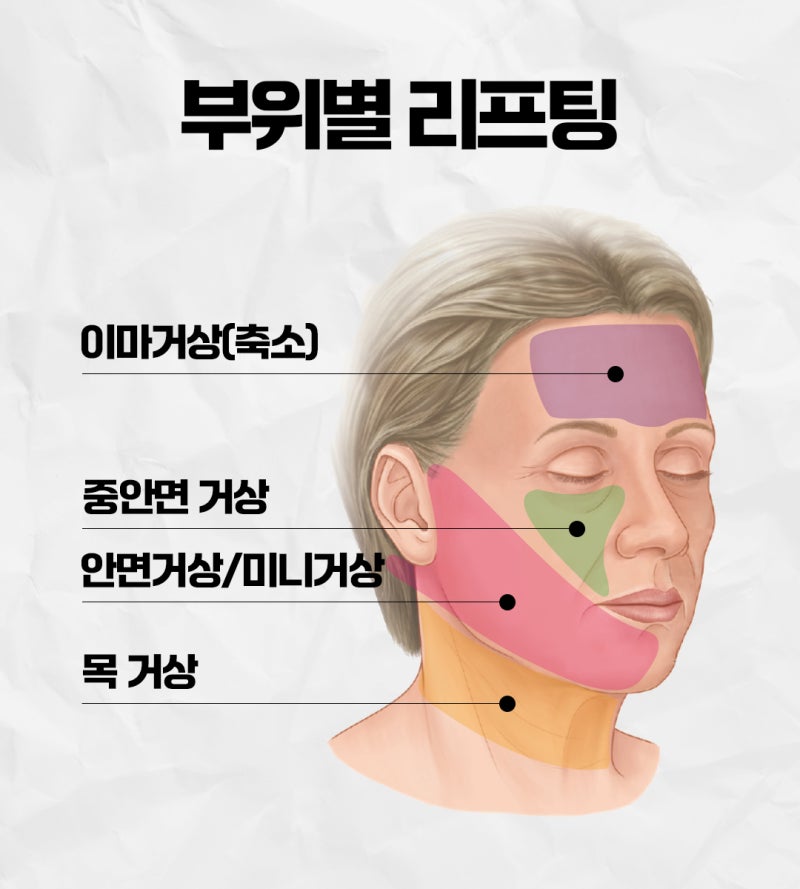
Furthermore, when aiming to improve
only specific areas of the face,
area-specific lifts can be considered.
For example, if you are concerned about wrinkles on the forehead and glabella, or a tired expression due to sagging eyebrows,
a forehead lift can improve the upper face.
Endoscopic forehead lifts involve minimal incisions,
reducing scar burden and
allowing for faster recovery.
For bulging under-eye fat or prominent nasolabial folds,
a mid-face lift is effective.
By lifting the area below the cheekbones and the front cheeks,
it fills in hollowed volumes, creating a more youthful
and three-dimensional appearance.
If you are concerned about your jawline and Busan neck wrinkles,
a neck lift can clearly define the jawline
and improve a double chin or Busan neck wrinkles.
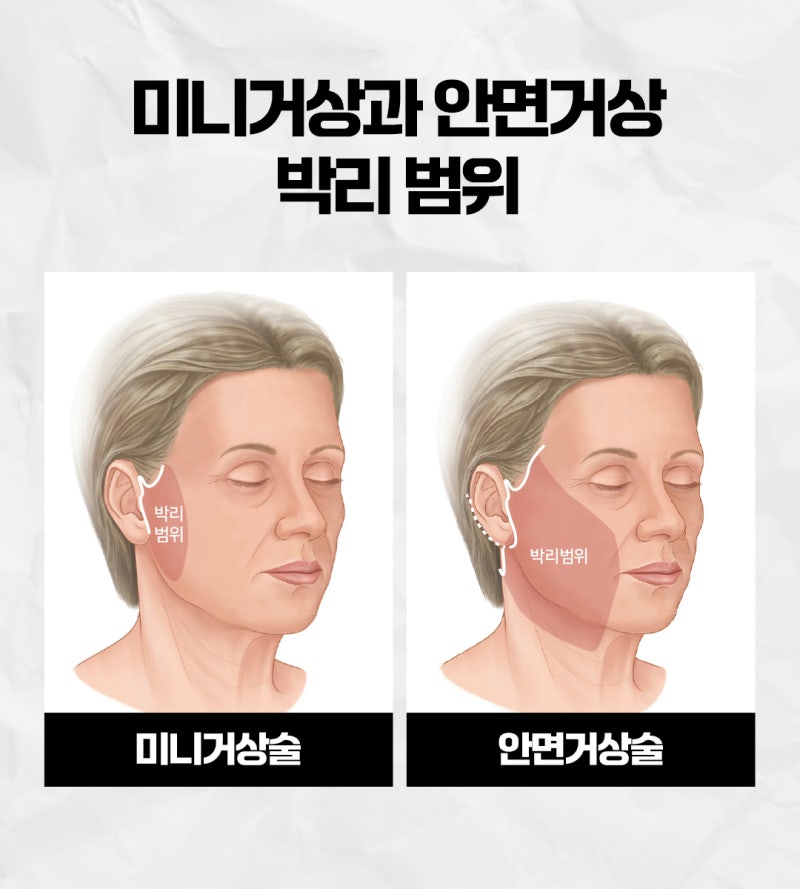
The biggest difference between a mini-facelift and a full facelift
lies in the incision and dissection range.
A full facelift is a surgery that can improve not only the face but also neck sagging,
involving a larger incision and longer surgery time, but by pulling
and fixing the muscles and SMAS layer, it provides clear effects
and fundamental improvement.
On the other hand, a mini-facelift has a smaller incision and dissection range,
resulting in less recovery burden but limited effects.
It can be considered when sagging is not severe and a thread lift alone
is insufficient, but choosing based solely on cost
may not yield the desired results.
Therefore, it is important to have a thorough consultation to determine the most suitable
method for you.
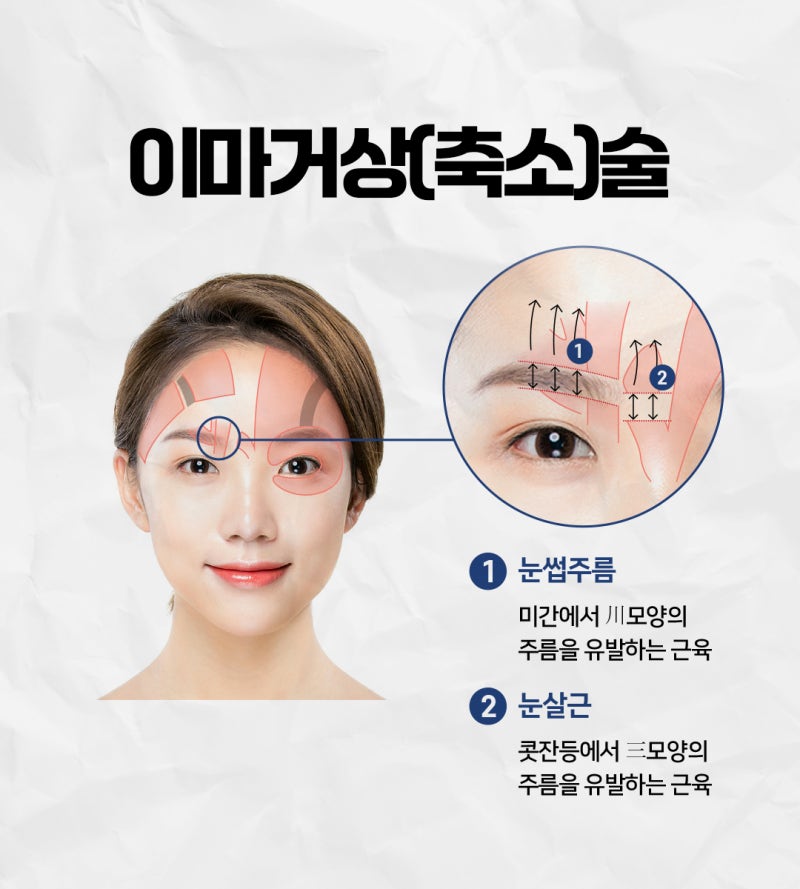
Although forehead lifts and eyebrow lifts use different surgical methods,
a forehead lift alone can also raise the eyebrows,
providing an eyebrow lifting effect.
If the dissection range is widened endoscopically,
sagging upper eyelids can also be improved, making tired-looking
eyes appear refreshed and brighter, and
helping to alleviate wrinkles on the glabella and bridge of the nose.
Incisions are made within the hairline,
making scars less noticeable, and
forehead reduction surgery requires
a zigzag incision along the hairline,
making post-operative scar management important.
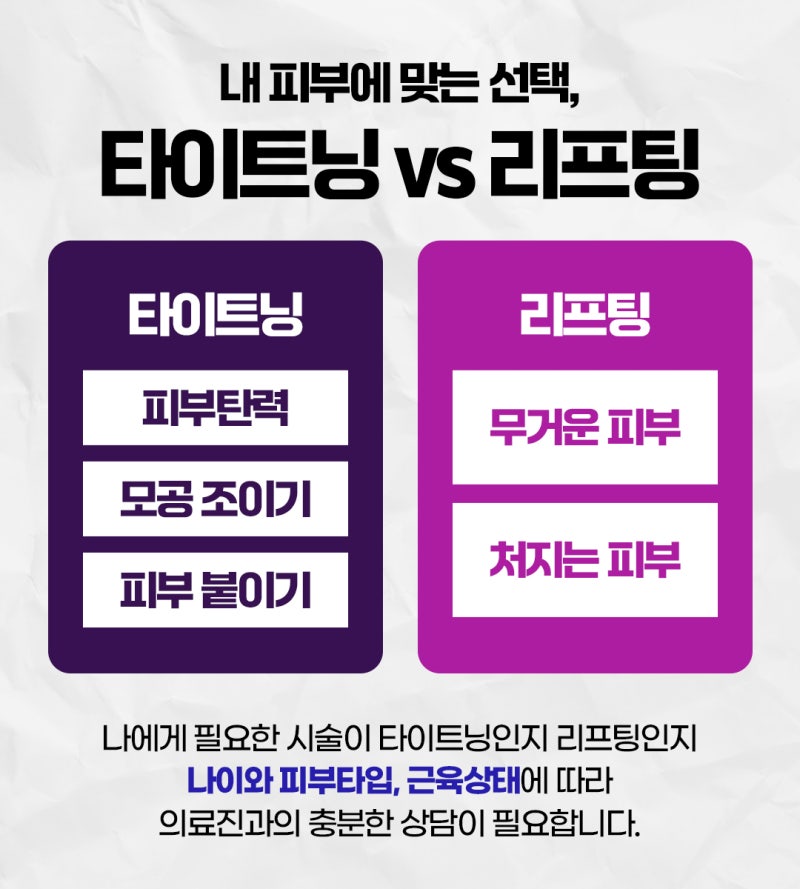
However, not everyone requires the same method of improvement;
the approach may vary depending on skin condition, age, and the degree of muscle changes.
Tightening helps restore skin surface elasticity, improve pores,
and firm the skin, making it suitable for
relatively mild sagging or
early stages of aging.
Lifting, on the other hand, focuses on improving structural changes
such as heavy, sagging skin, deep wrinkles,
and a collapsed jawline.
Therefore, what constitutes the right choice for you
is not simply the name of the procedure, but a comprehensive consideration of your skin type, age, and muscle condition,
and it is advisable to find the most suitable method through thorough consultation with medical professionals.
The important thing is to find a method that matches your facial condition and age.
Rather than blindly opting for an aggressive surgery,
it is crucial to make the optimal choice by comprehensively considering your skin elasticity, fat distribution, and muscle condition.