2026-09-14
Revision Double Eyelid Surgery in Seomyeon: The Process of Redesigning Eyes That Truly Suit You
Discover the detailed process of revision double eyelid surgery in Seomyeon, addressing asymmetry, releasing internal adhesions, and designing balanced, natural-looking eyes.


Hello, this is Four Seasons Plastic Surgery Clinic ^^
After an initial double eyelid surgery, some individuals may occasionally experience aesthetic or functional dissatisfaction.
Because the eyes play the most pivotal role in defining a person's overall impression,
even a subtle discrepancy in crease height or shape can impart a tired or stifled appearance.
In particular, asymmetry is rarely just a matter of the skin's surface;
it arises from an interplay of factors including the strength of the levator palpebrae superioris muscle (which opens the eye),
differences in skin thickness and laxity across both lids,
and internal tissue adhesions resulting from the previous surgery.
By anatomically pinpointing the exact root cause of asymmetry,
revision double eyelid surgery in Seomyeon focuses on restoring the overall balance of your eye shape rather than merely adjusting line heights.
If you are experiencing distress due to a previous unsatisfactory outcome,
the first step toward improvement is a meticulous structural diagnosis paired with personalized, delicate surgical planning.
The primary motivations for seeking revision double eyelid surgery in Seomyeon generally fall into three main categories:
First, double eyelid asymmetry caused by differences in crease height or anchor points after the initial procedure.
Asymmetry can become pronounced when one side loosens or when the fixation depth varies between the eyes.
Second, the desire for a higher crease when the initial line was set too low or when the skin has begun to sag over time.
When the original fold becomes obscured or looks like a hidden crease, revision surgery can recreate a more defined, visible line.
Third, a tired appearance due to inadequate pupil exposure, or an overall narrow eye shape where a clearer, more open look is desired.
These concerns often cannot be fully resolved through skin excision alone,
frequently requiring ptosis correction to strengthen eyelid-opening muscles alongside canthoplasty procedures.
Have questions? Feel free to reach out via Naver TalkTalk!
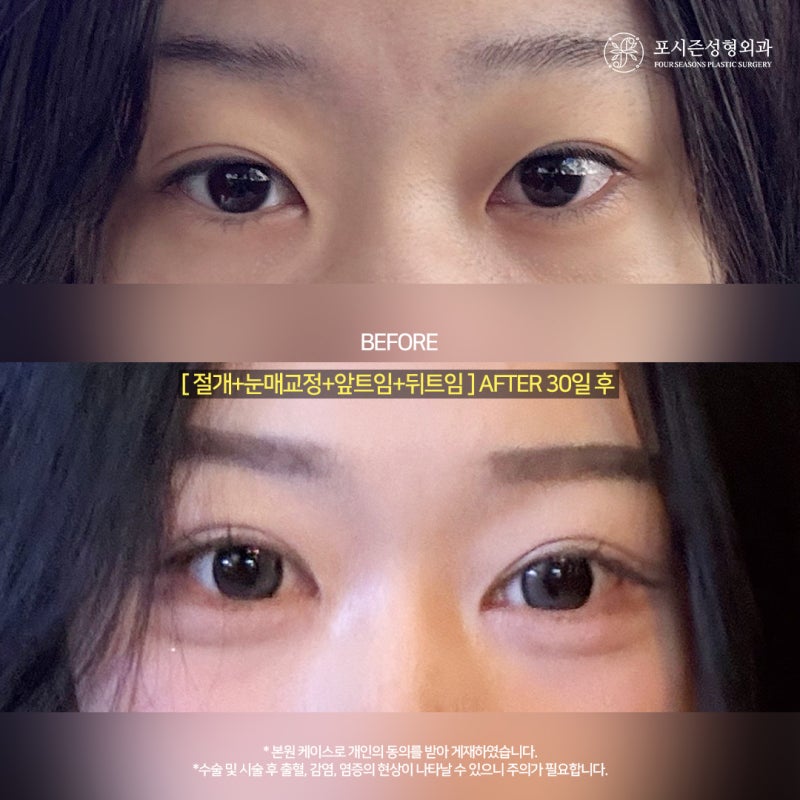
*This case features an actual patient of our clinic who provided consent for photo use.
*Complications such as bleeding, infection, and inflammation may occur following surgical or non-surgical procedures.
When revision double eyelid surgery is combined with ptosis correction and canthoplasty,
both aesthetic and functional shortcomings can be addressed comprehensively.
In the pre-operative case shown above,
the uneven heights of the eyelid creases resulted in an asymmetric and somewhat heavy look.
By performing revision blepharoplasty alongside ptosis correction and canthoplasty,
symmetrical creases were restored, achieving a significantly clearer and more open, refreshed gaze.
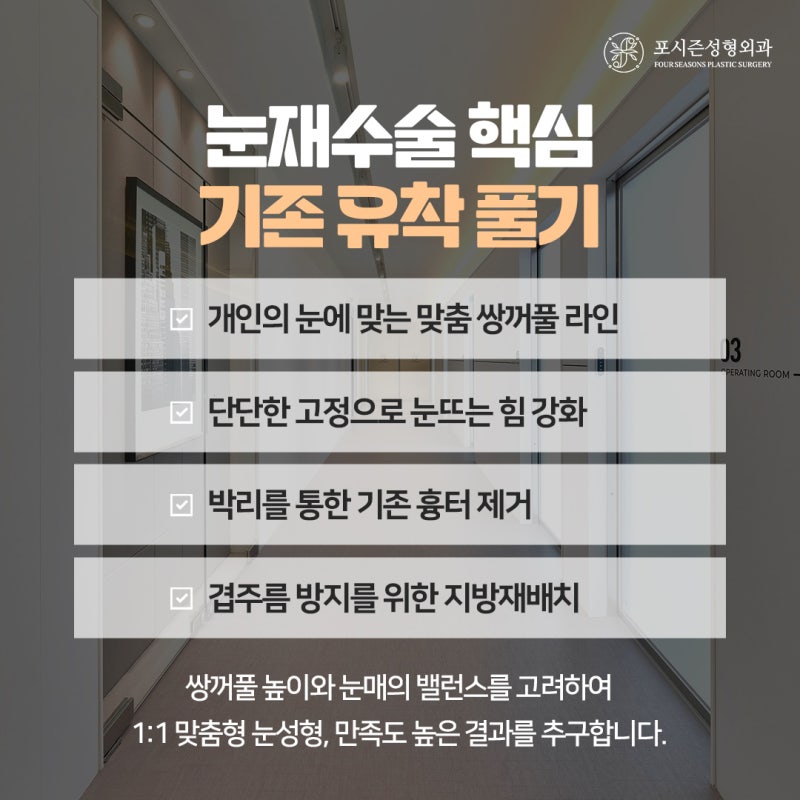
To secure truly satisfying results in revision double eyelid surgery,
a critical step is fully releasing existing adhesions.
If a new fold is created without thoroughly releasing the scar tissue and mispositioned internal adhesions from the prior procedure,
multiple folds (triple creases) may form, or the previous line may re-emerge.
To prevent this, delicate dissection is performed to clean away old scar tissue,
followed by redesigning an optimal, custom double eyelid line tailored to the individual's unique eye contours.
Simultaneously, secure tissue fixation reinforces the eyelid-lifting muscles to cultivate a well-defined eye shape,
while eyelid fat repositioning ensures a smooth contour and rigorously prevents unwanted multiple folds from forming.
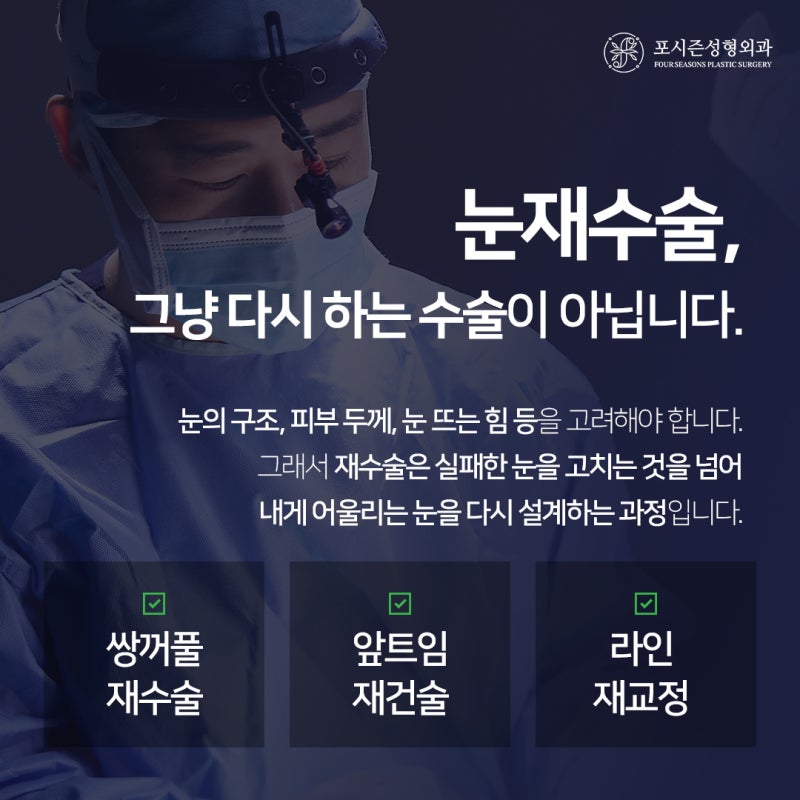
Revision double eyelid surgery in Seomyeon is far more than a simple touch-up or superficial surface adjustment.
It requires an in-depth, precise assessment of each patient's individual anatomical structure, skin thickness, elasticity, eyelid fat volume, and muscle opening strength.
In essence, revision blepharoplasty goes beyond just repairing previous issues;
it is an individualized process that redesigns the eye contours from the ground up to harmonize naturally with the patient's overall facial proportions and aesthetic vibe.
To achieve this, comprehensive and tailored solutions are formulated to address specific concerns—including revision double eyelid surgery,
epicanthoplasty reconstruction to restore tissue from excessive inner corner cuts or scarring,
and fine line readjustment to correct minute asymmetries.
Have questions? Feel free to reach out via Naver TalkTalk!

















Frequently Asked Questions
What causes asymmetry between the eyelids after double eyelid surgery?
Eyelid asymmetry stems not only from surface skin differences, but also from varying levator muscle strength, skin thickness and sagging, differing fixation depths from the prior procedure, and internal scar adhesions. Correcting asymmetry requires a precise anatomical analysis of all these contributing factors.
Why is it so important to release existing adhesions during revision surgery?
Failing to thoroughly release previous adhesions and scar tissue can cause multiple folds (triple eyelids) to form or allow the previous line to reappear. Meticulous surgical dissection is essential to clear scar tissue so the new, customized fold can anchor cleanly and smoothly.
Is it necessary to combine ptosis correction or canthoplasty with revision blepharoplasty?
Yes, combining these procedures is often beneficial if pupils appear hidden, giving a sleepy look, or if the eye opening feels restricted in width or height. When skin excision alone is insufficient, ptosis correction strengthens eyelid elevation while canthoplasty creates a more defined, refreshed, and open appearance.
Can a crease that has become too low or turned into a hidden fold be corrected?
Yes, revision double eyelid surgery in Seomyeon can redesign the crease to sit higher than the previous line. By evaluating skin condition, elasticity, and previous scarring, a symmetrical line can be repositioned at the ideal height.
How can the development of multiple or overlapping folds after revision surgery be prevented?
Preventing multiple folds involves fully dissecting old scar tissue and performing eyelid fat repositioning so the eyelid folds naturally and cleanly. Secure fixation of the eyelid-lifting muscles further ensures that unwanted secondary creases do not form.