2025-09-18
Seomyeon Revision Rhinoplasty: Finding the Right Implant for Your Nose
Seomyeon revision rhinoplasty is a complex procedure that requires careful consideration of various factors, including previous surgical outcomes and the materials used. It's crucial to choose an experienced medical team to ensure a satisfactory result.

The nose, depending on its shape and size,
significantly alters one's impression.
Whether speaking, smiling, or even with a neutral expression,
the proportion and position of the nose play a crucial role
in determining the overall balance of the face.
For this reason, if the expected results are not achieved
from the initial surgery,
many consider Seomyeon revision rhinoplasty.
Seomyeon revision rhinoplasty is not merely a process of
reshaping the nose;
it is a highly complex procedure that requires a thorough review
and treatment of any deformities caused by the previous surgery
and the materials used.
Due to its intricate nature, Seomyeon revision rhinoplasty
must be carefully performed by a medical team
with extensive experience and expertise.
As it directly impacts both the outcome and daily satisfaction,
a comprehensive analysis and decision-making process
from various perspectives are essential.

The reasons for using autologous tissue in Seomyeon revision rhinoplasty
are the reduced risk of side effects and the natural appearance it provides.
Since the patient's own tissue is utilized,
there is a lower chance of rejection or immune reactions,
which in turn reduces the risk of inflammation or infection.
Furthermore, it blends well with the skin,
resulting in a more natural look,
and is particularly helpful in reducing the visibility or displacement
of implants when applied to areas with thin skin.
Another reason for its use is that it settles stably over time,
ensuring long-lasting results.
Autologous tissue is especially useful in cases of revision rhinoplasty
where deformities, contracture, or scar tissue
have developed from previous surgeries.
When strengthening the nasal tip support or reinforcing damaged areas is needed,
septal cartilage, ear cartilage, autologous dermis, and autologous costal cartilage
are frequently used, each selected appropriately based on its characteristics
to ensure stable surgical outcomes.
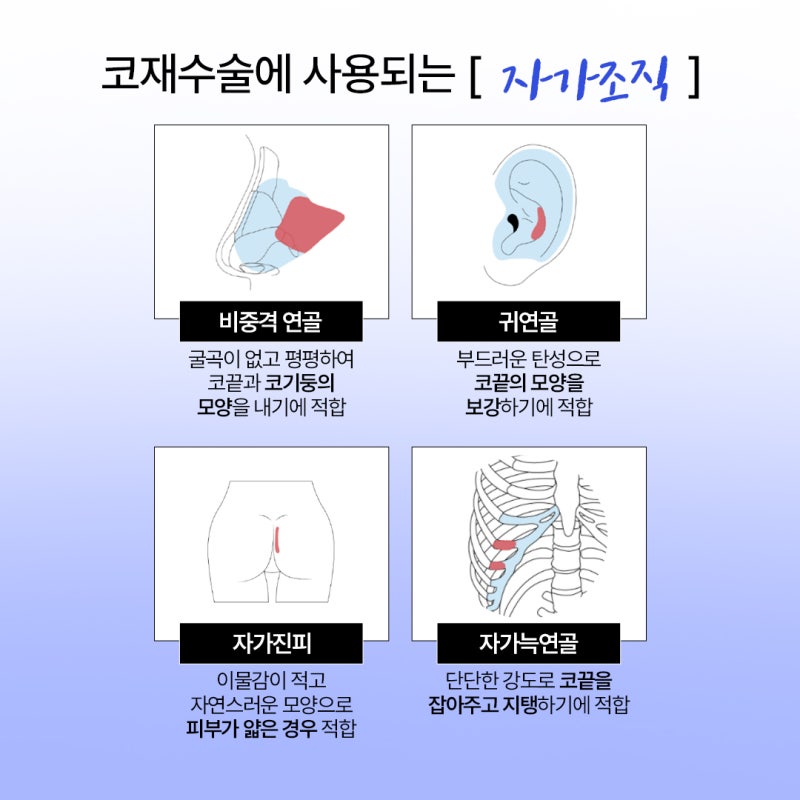
In Seomyeon revision rhinoplasty, autologous tissues are
selected based on their respective characteristics.
Septal cartilage, being mostly flat and without significant curvature,
is suitable for stably shaping the nasal tip or columella.
Ear cartilage is soft and elastic,
making it advantageous for complementing the shape of the nasal tip
or creating natural curves.
Autologous dermis causes less foreign body sensation and can provide natural volume,
making it effective for individuals with thin skin.
Autologous costal cartilage, with its firm strength,
is appropriate for supporting the nasal tip and firmly
establishing the overall structure.
Ultimately, autologous tissue is one of the important options
in Seomyeon revision rhinoplasty for achieving
natural and long-lasting results.
However, the amount of autologous tissue that can be harvested
is limited, and in some cases, it may be insufficient
to achieve the desired shape.
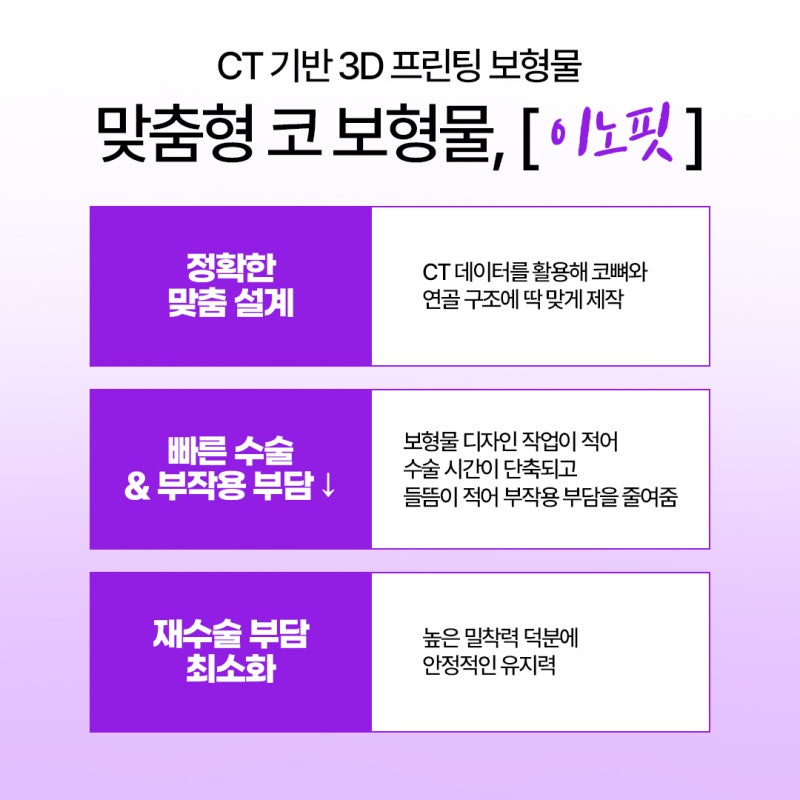
To compensate for these limitations,
the customized 3D implant system, Innofit, was introduced.
Innofit precisely analyzes the patient's facial and nasal structure using CT scans,
then virtually simulates the desired shape,
and based on that data,
custom-manufactures the implant.
This allows for a more concrete preview of the expected results before surgery
and stable outcomes that harmonize with the face
after the surgery.
The biggest feature of Innofit rhinoplasty is
the creation of personalized implants.
In traditional rhinoplasty, it was common to directly trim
pre-made implants during surgery,
which sometimes led to discrepancies between the patient's desired shape
and the actual outcome.
In contrast, Innofit precisely analyzes the patient's CT data,
including nasal bones, cartilage, and skin thickness,
to perform a virtual plastic surgery simulation
and designs the implant based on those results.
This allows patients to confirm the desired lines from various angles
even before surgery, making the outcome prediction more specific and clear.
Additionally, customized implants are manufactured to precisely fit
the nasal structure, which can reduce instances of lifting or transparency
after surgery and lower the risk of implant displacement.
The reduction in the separate process of implant fabrication
also shortens surgery time, which can positively impact
the recovery process.

Seomyeon revision rhinoplasty is a highly complex surgery
that demands a much more precise and delicate approach than the initial surgery.
Beyond simply replacing an implant or reshaping the nose,
it requires a thorough understanding of the materials used in the previous surgery,
any resulting deformities, contracture, and scar tissue
to expect stable results.
Especially with autologous tissue and customized implants like Innofit,
each has distinct characteristics, making it crucial
to choose appropriately based on the patient's condition and goals.