2025-10-30
Seomyeon Under-Eye Fat Repositioning: What You Must Know Before Finding a Good Clinic
Under-eye changes significantly impact overall facial impression. Sunken or protruding under-eye fat can create dark shadows, making one look older. Seomyeon under-eye fat repositioning surgery is a popular solution.

Changes around the eyes can significantly impact your overall facial impression.
Specifically, if the under-eye area is sunken or if fat protrudes,
the shadows beneath the eyes can resemble dark circles,
giving an older appearance.
This phenomenon is not merely due to skin aging but also
a complex interplay of fat migration, muscle relaxation, and changes in skin thickness.
For these reasons, Seomyeon under-eye fat repositioning surgery, which removes or repositions fat to balance the facial impression,
is emerging as a viable alternative.
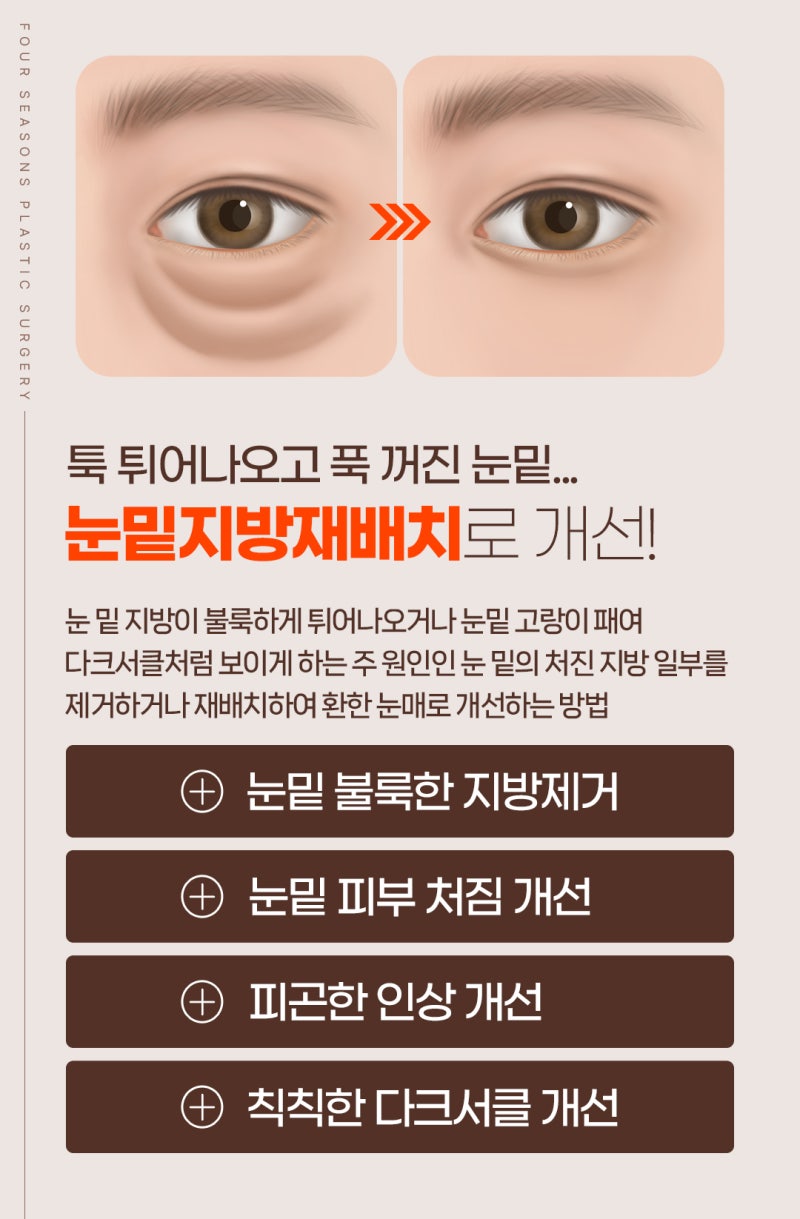
Seomyeon under-eye fat repositioning is a surgical procedure that
removes or repositions some of the sagging fat under the eyes,
which is the main cause of bulging under-eye fat or deep under-eye hollows that resemble dark circles.
Under-eye fat repositioning improves sagging under-eye skin by removing bulging under-eye fat
and alleviates dull dark circles.
As a result, it helps transform a tired impression into a softer and more vibrant one.
As interest in Seomyeon under-eye fat repositioning grows,
many people wonder if this surgery is right for them.
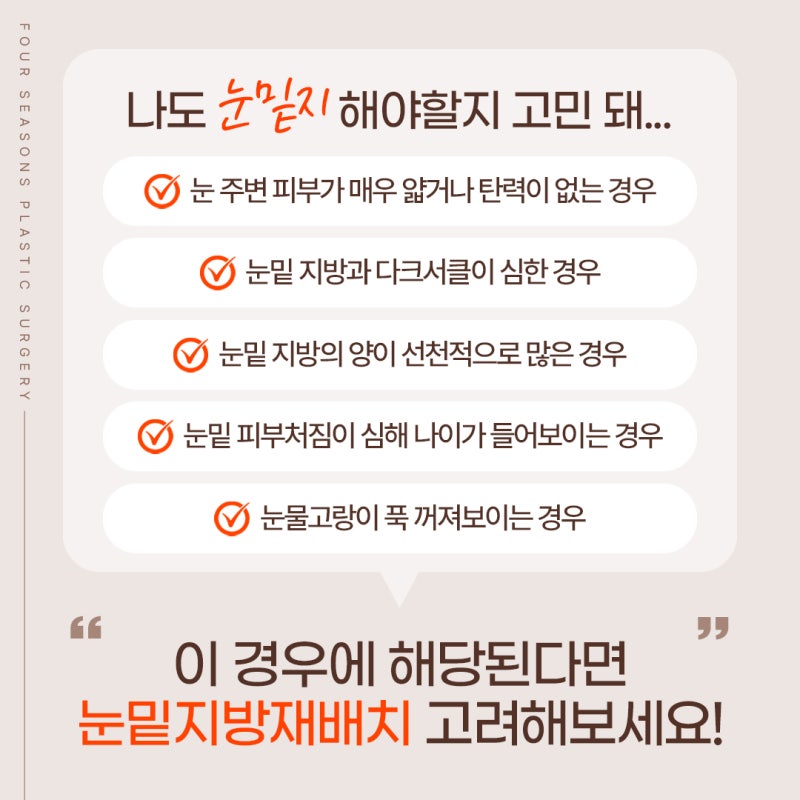
You might consider Seomyeon under-eye fat repositioning if:
- The skin around your eyes is very thin or lacks elasticity.
- You have severe under-eye fat and dark circles.
- You have a naturally large amount of under-eye fat.
- Severe under-eye skin sagging makes you look older.
- Your tear troughs appear deeply hollowed.
Before looking for a good clinic for Seomyeon under-eye fat repositioning,
there are several things you should check.
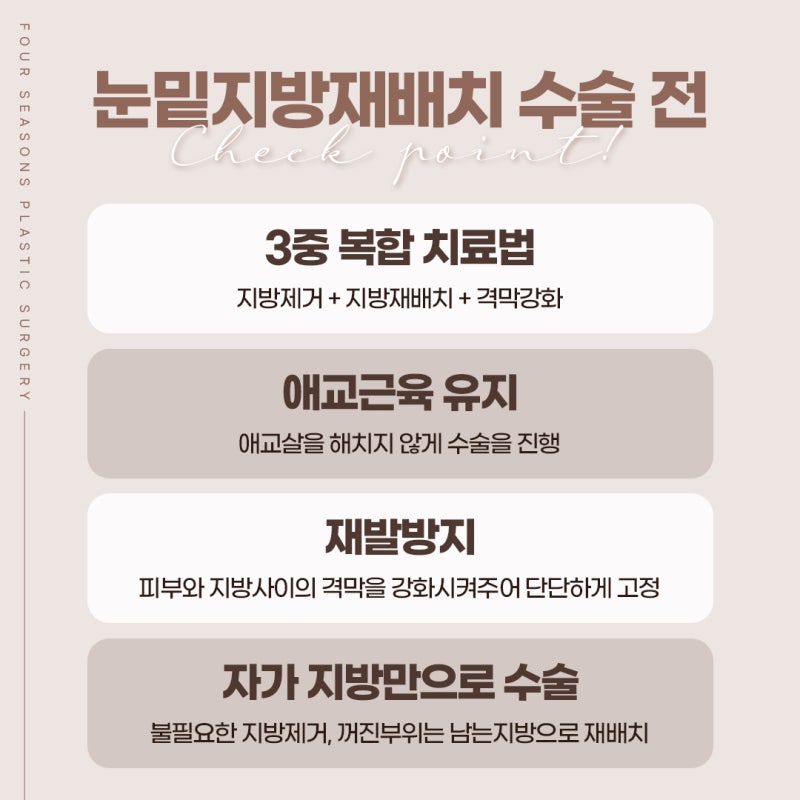
First, you should confirm if they perform a triple complex treatment involving fat removal, fat repositioning, and septal reinforcement.
Septal reinforcement addresses the primary cause of under-eye fat protrusion:
a weakened orbital septum.
This septum is a membrane that holds the fat in place, but as we age,
it thins and stretches, causing the fat to push forward.
Therefore, during surgery, while repositioning the fat, at the same stage,
this septum is tightened or reinforced with sutures to make it firm,
strengthening the support structure to prevent the fat from protruding again.
This process is crucial for preventing recurrence.
Secondly, you should ensure that the surgery is performed without damaging the ‘aegyo-sal’ (under-eye fat rolls).
Finally, it is best to choose a clinic that performs the surgery using only autologous fat.
Autologous fat has fewer immune rejection reactions than artificial fillers or foreign substances,
resulting in fewer side effects like inflammation
and a more natural under-eye improvement.
Seomyeon under-eye fat repositioning is not simply a procedure to move fat;
it is a delicate surgery where the approach must vary
depending on the individual's eye structure, skin thickness,
and fat distribution.
Since each person has different anatomical conditions, such as thin or less elastic under-eye skin,
or unevenly distributed fat,
the surgery cannot be performed in the same way for everyone.
Therefore, when planning Seomyeon under-eye fat repositioning,
it is essential to have a thorough consultation with a medical team
who has extensive surgical experience and a deep understanding of the anatomical structure around the eyes.
Careful planning of the most suitable surgical method, the extent of fat repositioning,
and whether septal reinforcement is needed is crucial
to achieve natural and stable results.