2026-08-04
Under-Eye Fat Repositioning: Improving Dark Circles and Bulging Under-Eyes Simultaneously
Under-eye fat repositioning can simultaneously improve dark circles and bulging under-eyes, creating a brighter, more youthful appearance. This procedure is ideal for those with prominent under-eye fat and tear troughs, offering a natural and long-lasting solution.

Under-Eye Fat Repositioning: Improving Dark Circles and Bulging Under-Eyes Simultaneously

Have you ever worried about your dull-looking under-eyes every time you look in the mirror?
Bulging fat under the eyes and deep tear troughs can make your overall impression look tired and are often the main culprits making you appear older than your actual age.
No matter how much you try to conceal them with high-performance concealer, the uneven shadows are not easily hidden.
To brighten such dull eyes that cannot be resolved with makeup alone and to achieve a smooth, clear, and youthful appearance, ‘under-eye fat repositioning’ is gaining attention as a leading alternative.
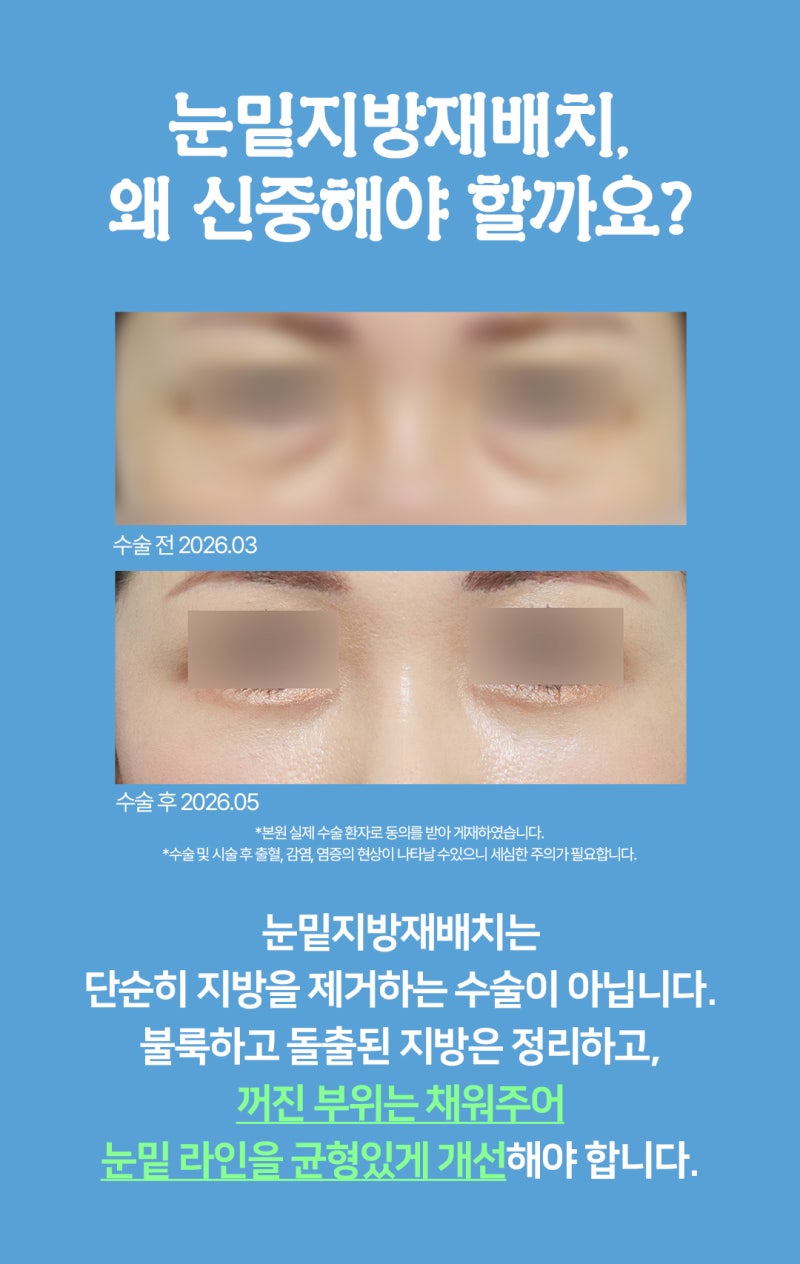
Why should under-eye fat repositioning be decided with caution?
When considering surgery, you should not make a decision based solely on cost or reviews.
This is because under-eye fat repositioning is not a one-dimensional surgery that simply cuts and removes excessively protruding fat.
The key is to neatly arrange the bulging and protruding fat under the eyes while appropriately filling in deeply sunken areas with fat to smoothly and harmoniously improve the entire under-eye line.
Accurately analyzing the shadows and lines under the eyes and improving them three-dimensionally is essential to reduce the risk of side effects and achieve satisfactory results, thus requiring delicate caution.

Advantages of under-eye fat repositioning, chosen by many
The biggest advantage is that it simultaneously improves both bulging and hollowness, creating a smooth and balanced under-eye line.
As the dark shadows under the eyes are alleviated, you can achieve a much brighter and more vibrant, youthful appearance.
Furthermore, since the procedure is often performed through an incision on the inside of the conjunctiva rather than on the outer skin, there is less burden regarding visible scars, which is a significant merit.
By not excessively removing fat and naturally repositioning one's own autologous fat, you can expect a natural change in the eyes that does not look artificial.
Under-eye fat repositioning vs. Lower blepharoplasty: Which surgery is right for my eyes?
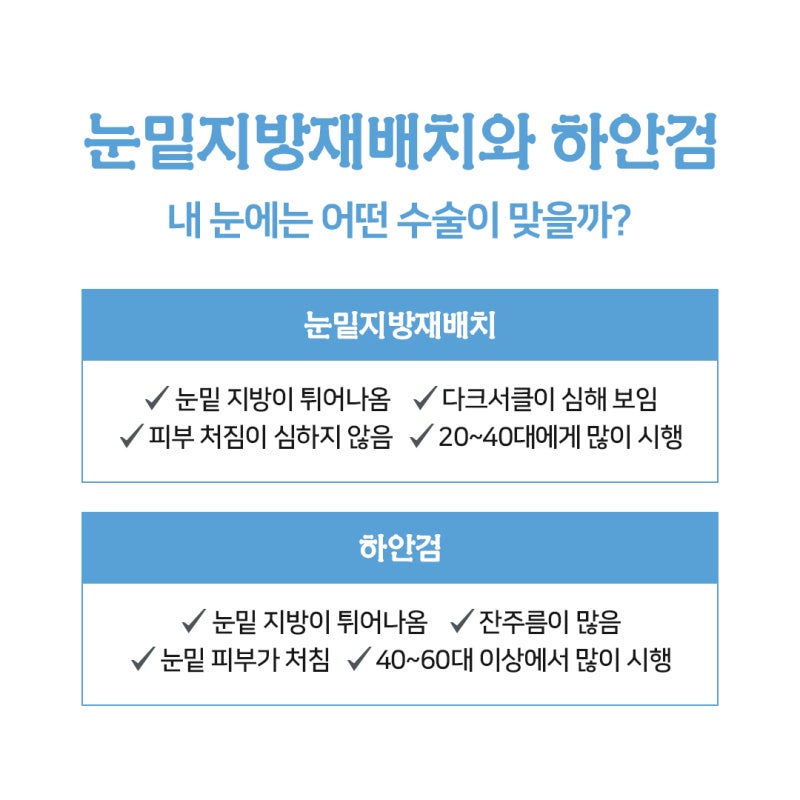
In addition to under-eye fat repositioning, ‘lower blepharoplasty’ is another method to address under-eye concerns, so it is important to find the surgical method that suits you.
Under-eye fat repositioning is typically performed on individuals in their 20s to 40s who have protruding under-eye fat and severe dark circles but not severe skin laxity.
On the other hand, lower blepharoplasty is a more suitable method for individuals aged 40s to 60s and older who have fat protrusion along with severe under-eye skin laxity and many fine wrinkles.
As such, the applicable surgical method varies depending on your age, skin elasticity, and the degree of wrinkles, so an accurate diagnosis must be prioritized.

4 Key Points to Know Before Surgery
To maintain a satisfactory under-eye line for a long time, there are essential points to check.
First, you should confirm whether it is a triple complex treatment that simultaneously performs fat removal, repositioning, and septal reinforcement.
Second, you should carefully check if the surgery is performed while preserving the natural shape of the under-eye fat (aegyo-sal) without damaging it.
Third, the orbital septum between the skin and fat must be strongly reinforced and firmly fixed to prevent recurrence of fat protrusion after surgery.
Lastly, whether the surgery is performed using only pure autologous fat, not unnecessary foreign substances, and whether the remaining fat is efficiently repositioned into sunken areas can determine the outcome.

A delicate surgical plan can determine the results of under-eye fat repositioning.
The eye area is a part of our body with thin and sensitive skin structure.
Therefore, an anatomical understanding and a delicate plan that comprehensively considers each individual's varying degree of fat protrusion, depth of tear troughs, and skin elasticity level are necessary.
For successful under-eye fat repositioning, it is crucial to design a surgical plan through consultation with medical staff who can precisely measure the characteristics of the periorbital tissues and establish a customized surgical plan, going beyond simple surgical execution.