2025-07-29
Under-Eye Fat Repositioning: When Bulging Under-Eyes and Dark Circles Are a Concern
Under-eye fat repositioning and lower blepharoplasty can revitalize a tired, aged appearance caused by bulging under-eyes and dark circles. This procedure not only removes excess fat but also redistributes it to hollow areas, creating a brighter, more youthful look.


Under-Eye Fat Repositioning: When Bulging Under-Eyes and Dark Circles Are a Concern

Every time you look in the mirror,
do you sigh at your bulging under-eyes
and prominent dark circles?
If you're concerned about looking tired
or older than your age,
under-eye fat repositioning and lower blepharoplasty
can significantly improve a dull impression
into a more vibrant face.
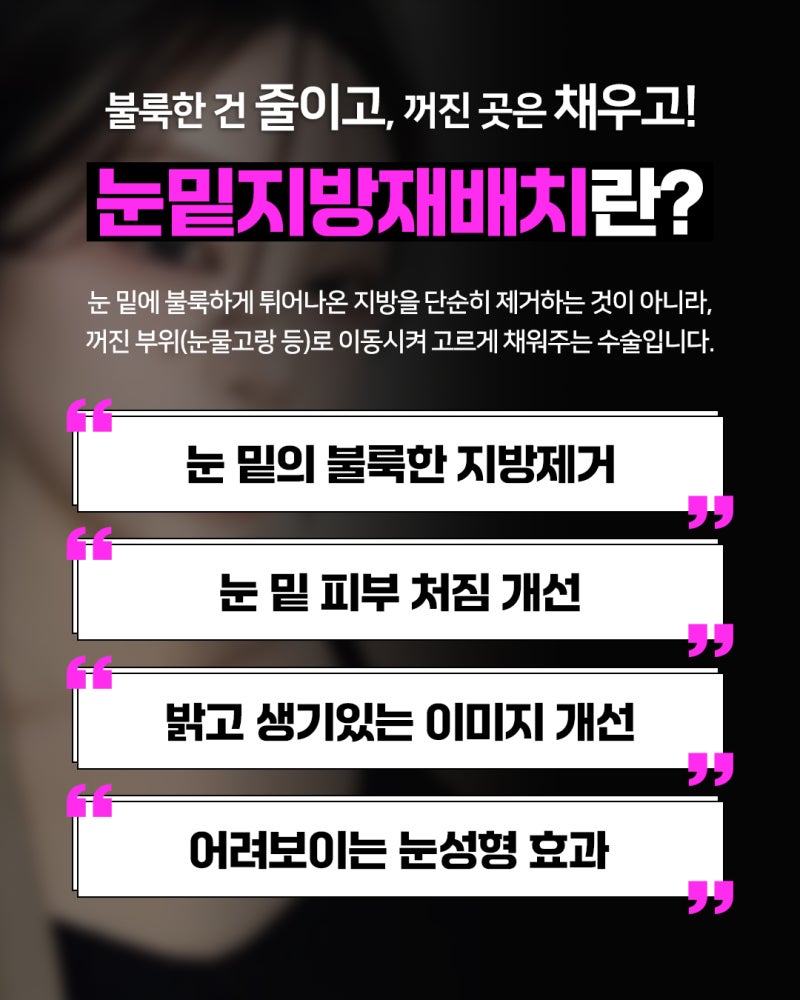
What is under-eye fat repositioning?
It's a procedure that not only removes
the bulging fat under the eyes
but also moves it to hollow areas (like tear troughs)
to fill them evenly.
Under-eye fat repositioning
reduces bulging under-eye fat
and fills in hollow areas,
improving the eyes to look more vibrant and defined.
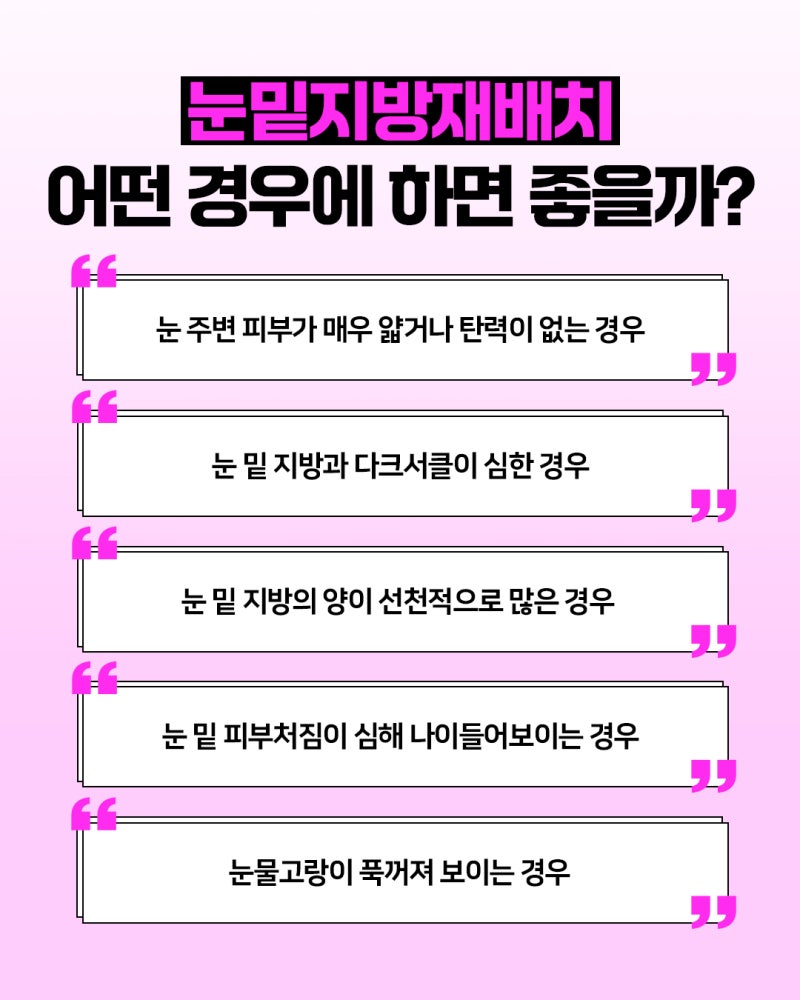
So, when is it best to consider under-eye fat repositioning
versus under-eye fat removal?
If the skin around your eyes is very thin or lacks elasticity,
if you have severe under-eye fat and dark circles,
if you have a naturally large amount of under-eye fat,
if severe under-eye skin sagging makes you look older,
if your tear troughs appear deeply sunken, etc.
If you have any other under-eye concerns,
it's worth considering this procedure.
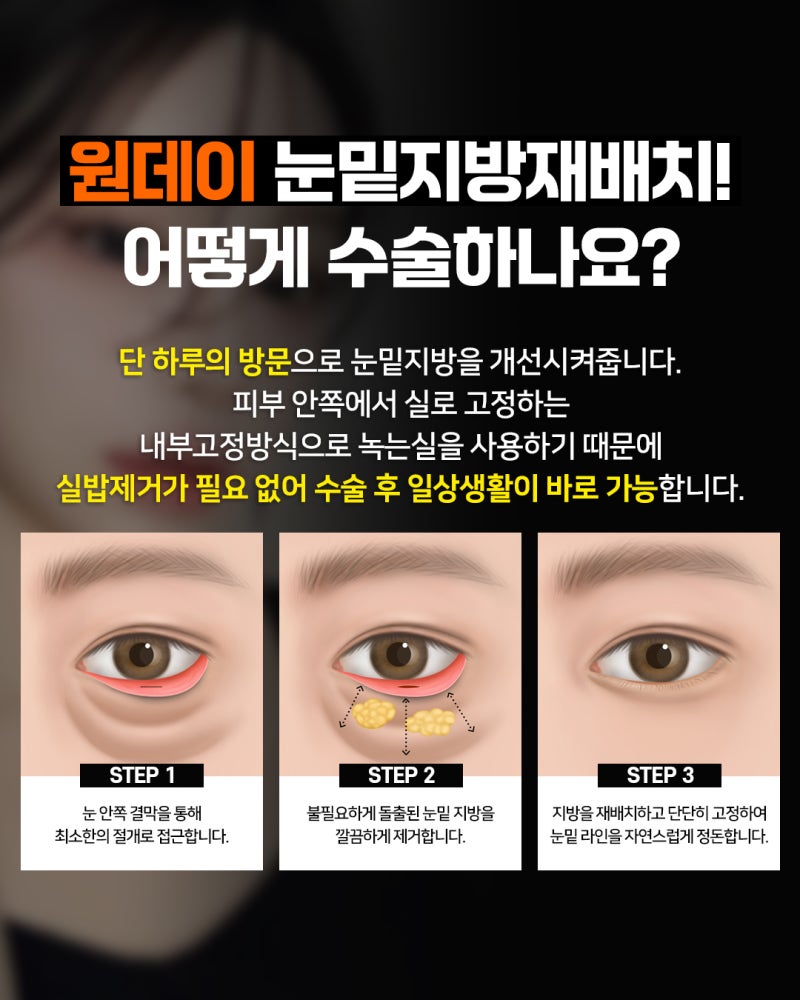
Typically, ‘One-Day Under-Eye Fat Repositioning’
is a surgical method that improves the condition
by removing and repositioning under-eye fat
in just one visit.
Since it's accessed through a minimal incision
via the inner conjunctiva of the eye,
you don't have to worry about scars.
Afterward, unnecessary protruding under-eye fat is
neatly removed and redistributed,
then firmly fixed to naturally refine
the under-eye line.
One-Day Under-Eye Fat Repositioning
uses an internal fixation method, securing with dissolvable sutures
from inside the skin, so
suture removal is not necessary.
Not only can you resume daily life immediately after surgery,
but the absence of scars
makes it a preferred method for many.
In addition to under-eye fat repositioning,
there are various other methods
that can help with under-eye concerns.
Depending on your individual condition,
lower blepharoplasty or fat grafting may also be considered.
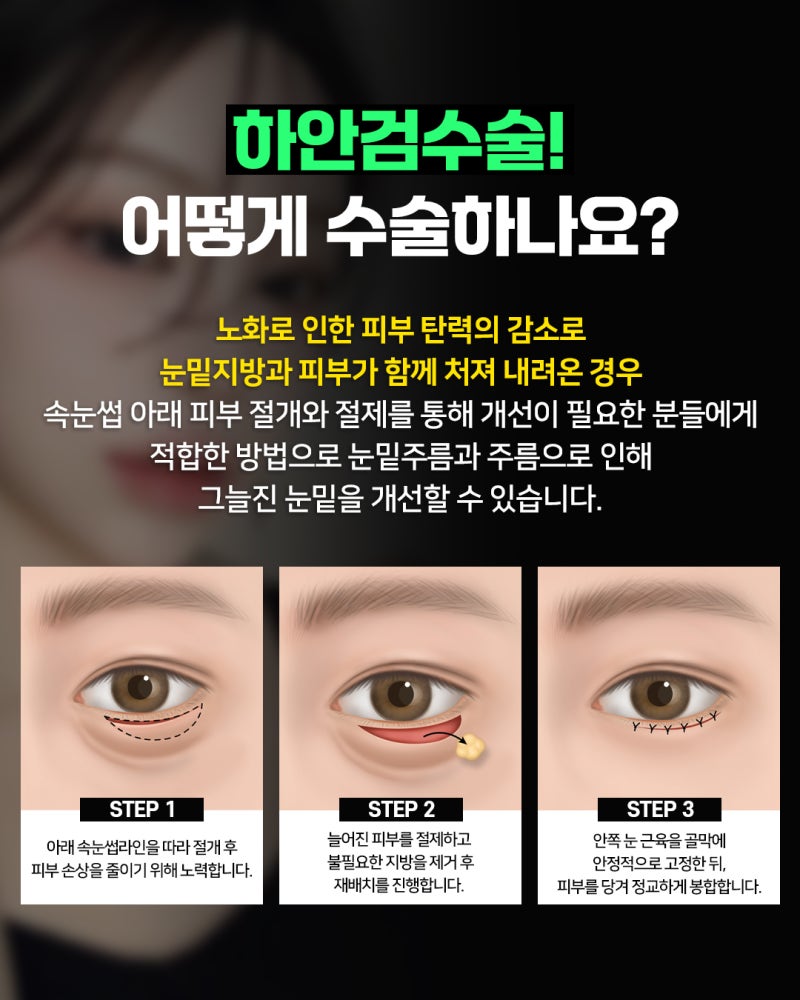
What is lower blepharoplasty?
Due to reduced skin elasticity from aging,
it is primarily suitable for individuals aged 40 and above
who have sagging under-eye fat and skin.
It's an appropriate method for those who need improvement
through skin incision and excision below the eyelashes.
Lower blepharoplasty can improve
shadowed under-eyes caused by
under-eye wrinkles and crow's feet.
The surgical method involves an incision along the lower lash line,
excision of sagging skin,
and removal and repositioning of unnecessary fat.
Finally,
it's a procedure that involves fixing the inner eye muscle to the periosteum
through lateral canthoplasty,
then pulling the skin and meticulously suturing it.
In addition to removing and
repositioning under-eye fat,
there's also a method of grafting fat in reverse.
Fat grafting is a procedure that involves
injecting fat extracted from your own body
into hollow areas of the face or body
to restore volume.
Fat is typically harvested from areas like the thighs or abdomen,
purified, and then grafted.
Through fat grafting,
filling the volume in hollow areas
can alleviate wrinkles around the eyes.
This results in a rejuvenating effect,
making it a suitable surgery for those
with many wrinkles around the eyes.

If you're considering under-eye fat repositioning,
there are four checklists you should review.
The first is
that it involves a triple complex treatment method of
under-eye fat removal, fat repositioning, and septal reinforcement.
It's good to check if a comprehensive approach
can address various causes at once.
The second is
to confirm whether the surgery is performed while preserving the ‘aegyo’ muscle (under-eye fat roll).
The surgery should be performed while maintaining the aegyo muscle
to avoid harming the aegyo-sal.
The third is
to ensure that the septum between the skin and fat
is strengthened and firmly fixed
to prevent recurrence.
If the septum under the eyes weakens,
the fat can push forward again, so
it's necessary to check if efforts are being made
to prevent recurrence.
Lastly,
it's to confirm whether the surgery is performed using only autologous fat,
and if the hollow areas are repositioned with the remaining fat
while unnecessary fat is removed.
Surgery using only autologous fat increases the engraftment rate,
allowing for long-lasting results
and a more natural improvement with less foreign body sensation
when touched.
The under-eye area is
the first part of the face to show signs of aging
and a crucial factor that influences overall impression.
Even for simple skin sagging or
fat protrusion,
the approach should vary depending on the cause and condition.
Under-eye concerns arising from various causes
require personalized improvement.
We recommend finding the most suitable method
through thorough consultation with medical staff
before making a decision.