2026-02-19
Why Autologous Tissue is Used for Hump Nose Correction in Busan
The nose, located at the center of the face, can significantly impact one's overall impression with even minor changes. Many people worry about their nose shape due to a low bridge, wide tip, broad nostrils, or a crooked profile.


Hello. This is Four Seasons Plastic Surgery Clinic.
The nose is located at the center of the face, and even small changes
can significantly impact one's overall impression.
Many people worry about their nose shape due to various reasons such as a low nasal bridge, a wide-looking nasal tip, broad nostrils, or a crooked profile, and these concerns can affect their daily confidence.
Rhinoplasty is not simply about increasing height;
it is crucial to analyze an individual's structural characteristics, considering facial proportions and harmony,
and then determine the appropriate direction.
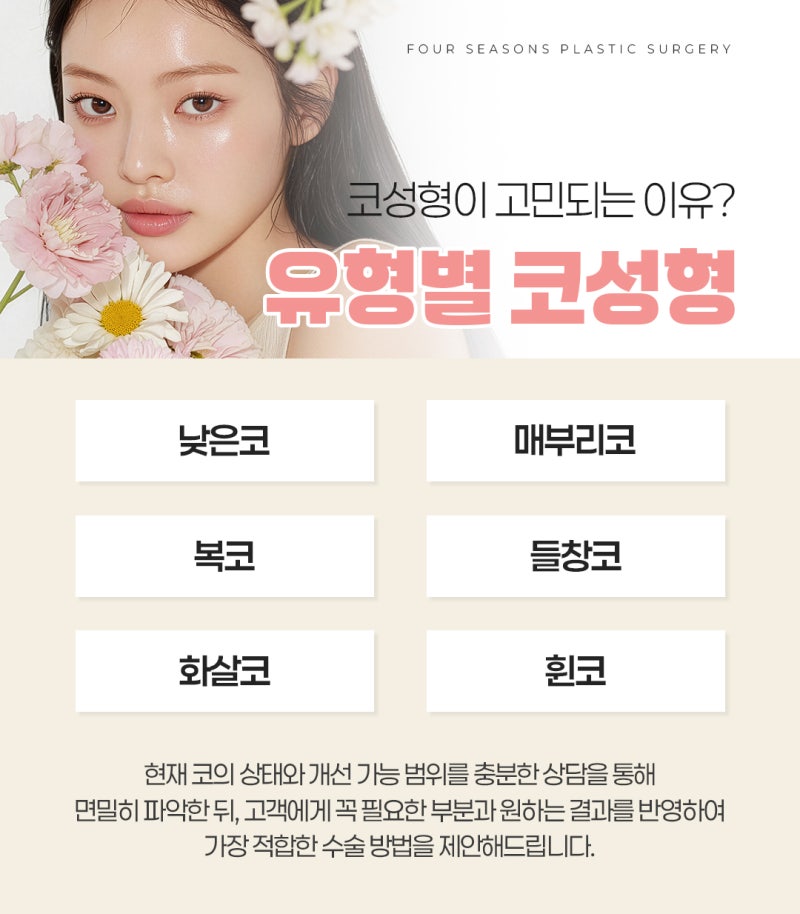
For various reasons, such as a low nose, hump nose, bulbous nose, upturned nose, or crooked nose,
many consider hump nose correction in Busan.
Concerns about the nose vary greatly depending on its shape, structure, and proportions,
and each individual's desired outcome can also
differ. Therefore, it is important to thoroughly understand the current state of the nose
and the scope of possible improvements through sufficient consultation,
and to reflect the necessary parts and desired results to find the most suitable hump nose surgery method in Busan.
Among those considering rhinoplasty, some simply want to raise their nasal bridge,
but many also suffer from a hump nose in Busan, where the middle of the nasal bridge protrudes.
A hump nose refers to a nose shape where the junction of the nasal bone and cartilage protrudes,
appearing like a bird's beak from the side profile.
Since it is more prominent from the side than the front, it can significantly affect one's image,
and people often consider correction because it can make their impression seem strong or sharp.
A hump nose in Busan can be congenital,
or it can develop during growth if the nasal septum overdevelops,
affecting the nasal bone and causing a protrusion.
There are also cases where it is acquired after trauma or an accident,
resulting in a hump shape. As the causes are diverse, the correction method also varies depending on the individual's
nasal structure and condition.

For hump nose correction in Busan, different surgical methods are considered depending on the individual's situation.
If the hump is not severe, correction can be achieved by simply refining the protruding area.
This involves precisely excising or trimming the prominent bone and cartilage to create a smoother line.
At this time, the overall balance of the nose must be considered to achieve a natural side profile.
If a low nasal bridge is accompanied by a hump, simple excision alone may not be sufficient for improvement.
After refining the protruding area, a method that uses implants or autologous tissue to supplement the nasal bridge
and align the overall line is considered. Especially in hump noses,
the nasal tip often appears droopy, so a plan to balance it by combining nasal tip surgery is often made.
If the hump protrusion is severe and the nose width is wide,
a process of osteotomy to narrow the nasal bones along with hump excision may be necessary.
This aims to reduce the width of the nose and bring it to the center to create a more refined line.
However, the decision for osteotomy should be carefully made based on the individual's bone structure.
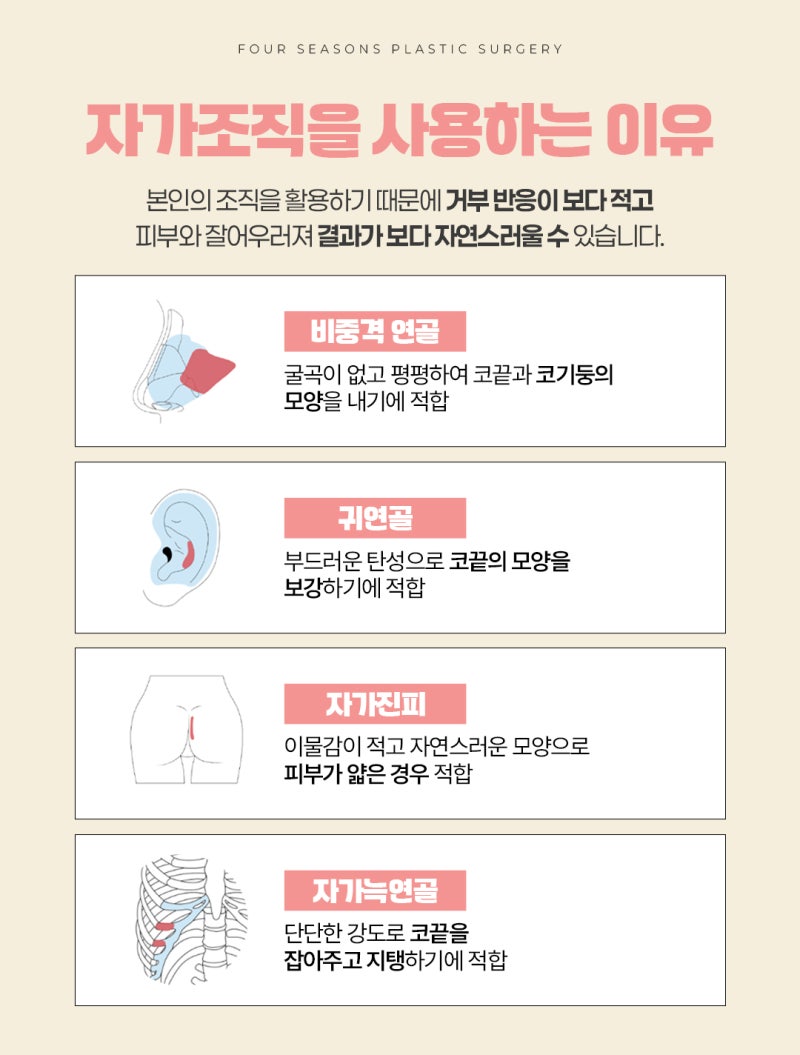
The reason for using autologous tissue in rhinoplasty is also an important consideration.
Utilizing one's own tissue can help reduce the possibility of foreign body reactions
and has advantages in terms of harmony with the skin. For example, septal cartilage is relatively
flat and firm, used to create the shape of the nasal tip and columella,
while ear cartilage is elastic and used to reinforce the shape of the nasal tip.
Autologous dermis can help soften the contour of an implant if the skin is thin,
and autologous costal cartilage is strong, making it suitable for supporting the nasal tip.
Concerns about nose shape vary for each individual,
but the process of finding a direction that suits one's facial proportions and structure is paramount.
For various nose shapes, including hump noses, a more balanced change can be expected when a personalized plan is made through accurate diagnosis and consultation.