2026-10-08
Still Stuck After Dieting? Check Whether It's Fat or Glandular Tissue – Gynecomastia Surgery in Busan
Explains how to tell whether a man's chest enlargement is fat or glandular tissue, outlines the three gynecomastia types, why exercise often falls short, and insurance coverage by stage.

Have questions? Message us on Naver TalkTalk!
Whenever you wear a thin shirt, your chest stands out and it's a constant source of worry.
Many men find that their chest won't budge even with regular exercise and diet.
In such cases, the first step is to determine whether what fills the chest is fat or glandular tissue.
This article covers the signs that may point to gynecomastia, its three types, and why it's hard to reduce with exercise,
as well as pre-surgery testing, surgical methods, and insurance coverage by stage.

These are the moments when gynecomastia becomes a concern.
Gynecomastia (female-type breast enlargement in men) refers to a condition in which a man's chest develops a rounded, feminine shape.
It's easy to dismiss it as simply weight gain and leave it alone,
but it can make you self-conscious about your clothing and posture, leading to feelings of insecurity and stress.
When choosing clothes – thin T-shirts or light-colored tops make the chest stand out, so you end up using chest patches or only wearing dark clothing.
In front of others – worried about how people look at you, you unconsciously end up hunching your shoulders.
Even when dieting – other areas slim down with diet and cardio, but only the chest stays the same.
The items below are a self-check list for gynecomastia.
My chest doesn't slim down even when I diet.
My chest is noticeably more developed than other people's.
I often hear comments that my chest looks like a woman's.
My chest feels like it jiggles when I run or move around.
Even with a slim build, I have chest sagging or nipple protrusion.
I can feel a lump in my chest.
Self-checks are for reference only,
so if you notice any of these symptoms, it's best to see a doctor to confirm your condition.
Fat type or glandular type? – The three types of gynecomastia
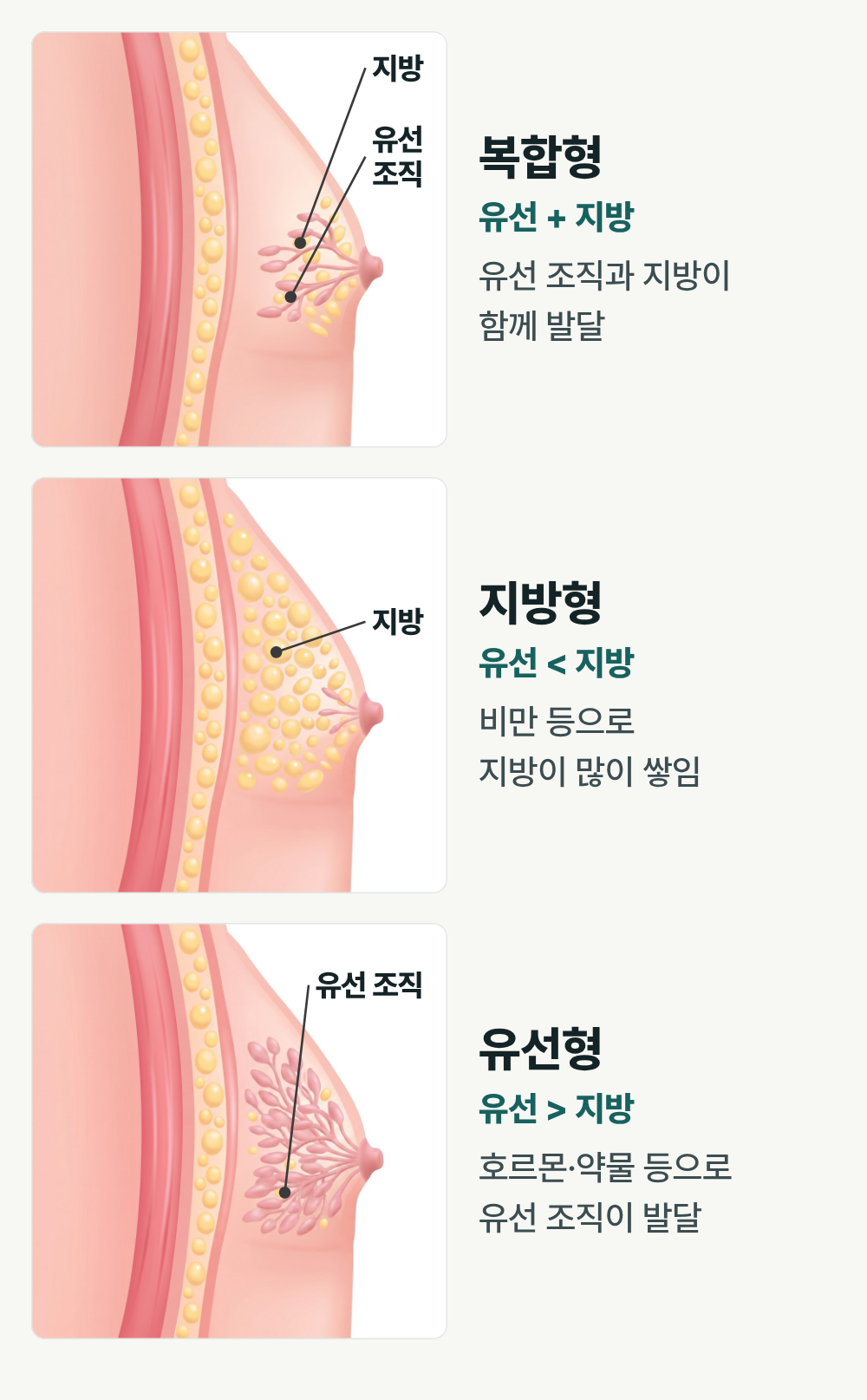
Gynecomastia can generally present in three types.
First, the mixed type is where both glandular tissue and fat have developed together, and it is the most common type.
The fat type has little glandular tissue, with fat accumulating in the chest due to factors such as obesity.
Finally, the glandular type is where glandular tissue has developed more than fat due to
hormonal imbalances or the use of certain medications.
Cases where the nipple and areola stand out despite a slim build may fall under this type.
What and how much to remove depends on whether there is more fat or more glandular tissue.
That's why gynecomastia is evaluated by examining the internal tissue first, rather than relying on appearance alone.
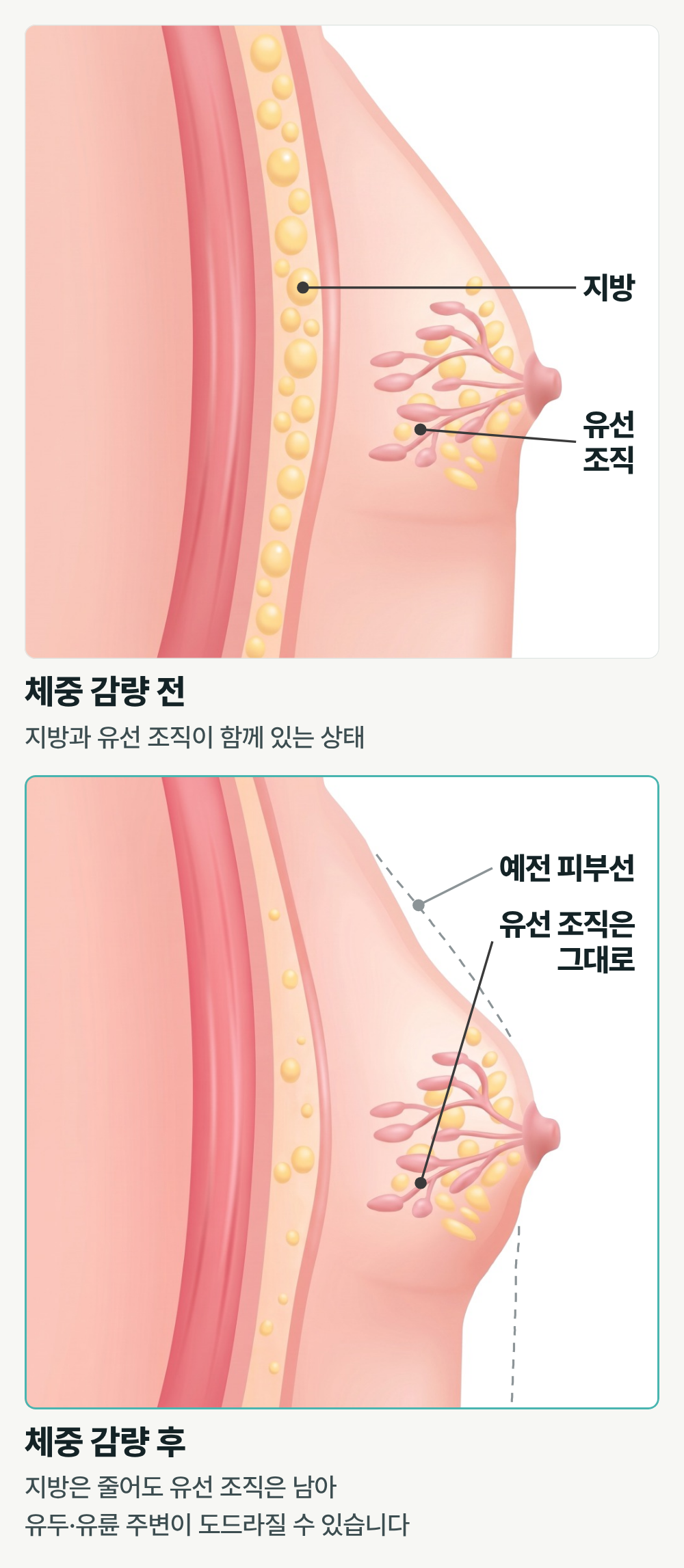
Glandular tissue is difficult to reduce with exercise alone.
There isn't just one cause of a rounded chest.
Temporary hormonal imbalances during puberty, certain diseases or medication use,
obesity from weight gain, and congenital factors all work together.
That's why many people assume it's simply obesity and start with exercise and diet.
However, unlike fat, glandular tissue
is a firm, fibrous tissue that doesn't shrink easily with exercise or diet.
When glandular tissue has also developed, the more you diet,
the more surrounding fat is lost, making the chest look even more prominent.
Gynecomastia surgery in Busan involves checking three things, from pre-op testing to incision.
Gynecomastia surgery in Busan isn't just about reducing visible volume,
but about deciding what to remove and what to keep based on the type identified through testing.
Ultrasound exam – Breast tissue, fat, and nerves are checked by ultrasound, and a treatment plan is set.
Glandular tissue removal and fat preservation – Developed glandular tissue is removed, while about 3–5 mm of fat is left behind to prevent the chest from caving in or the skin from sinking after surgery.
Incision below the areola – A small incision of about 5 mm is made below the areola, and the surgery is performed to preserve the original shape of the areola.
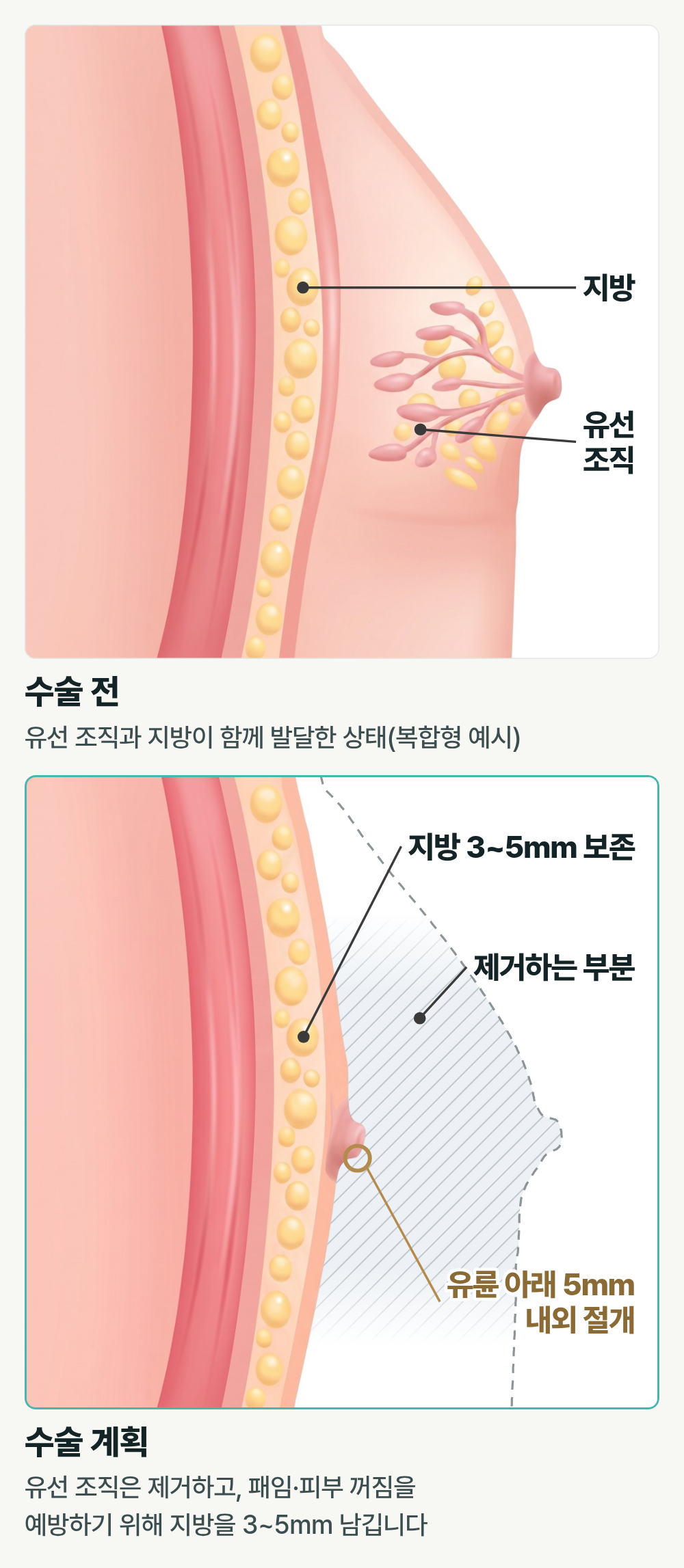
It may seem like the goal is to make the chest completely flat, but
removing both glandular tissue and fat
can leave the area below the areola sunken or the surface uneven.
That's why the thickness of the fat to be left behind is also factored into the plan.
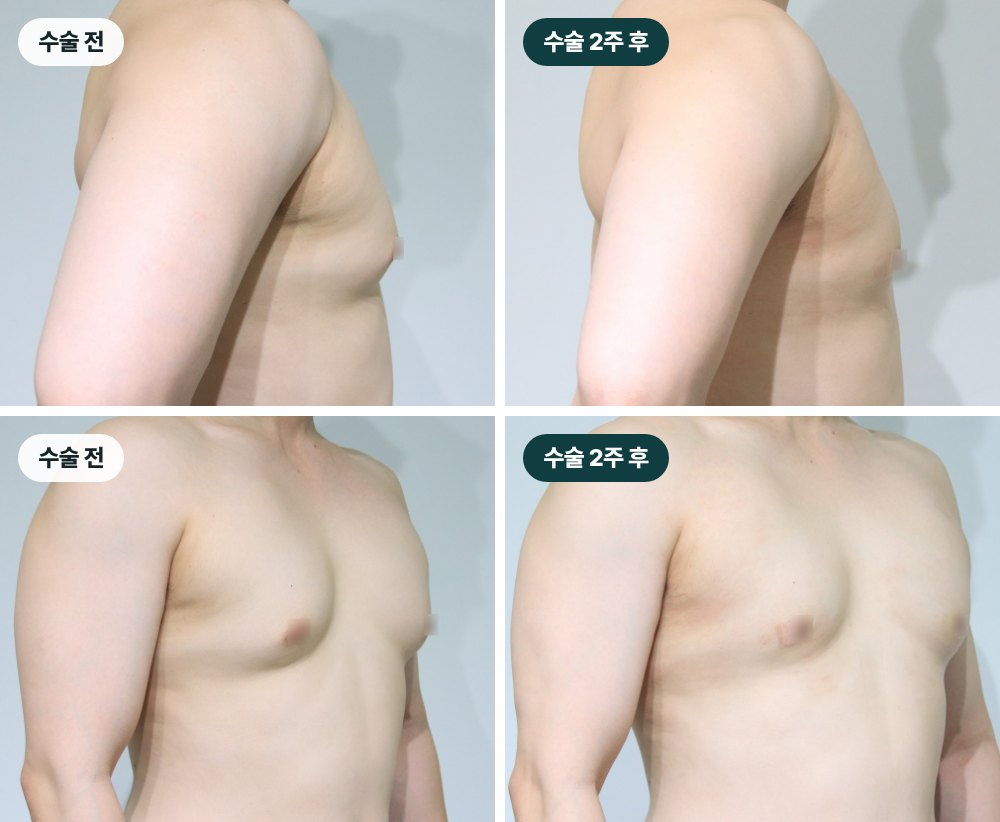
Before and 2 weeks after surgery: a man's chest shown from the side and at an angle.
Insurance coverage varies by stage.
Gynecomastia is staged by severity using the Simon classification (Simon grade).
Gynecomastia surgery in Busan is not only for cosmetic purposes;
it also has a medical treatment aspect, so insurance coverage depends on the stage.
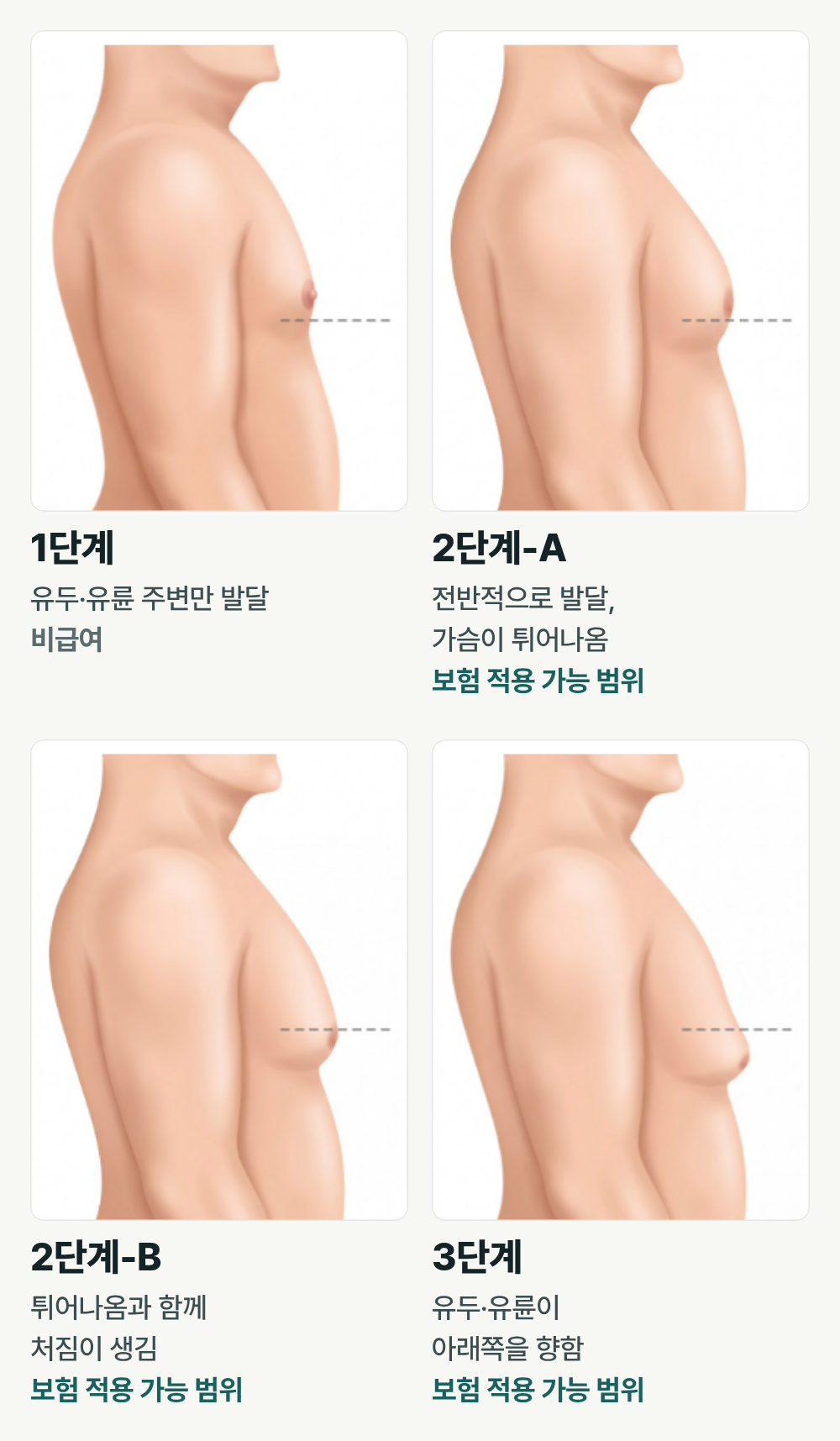
Stage | Condition | Insurance Coverage |
Stage 1 | Glandular tissue is small, with development limited to the area around the nipple and areola | Not covered |
Stage 2-A | Glandular tissue has developed overall, causing the chest to protrude | Eligible |
Stage 2-B | The chest protrudes and sags | Eligible |
Stage 3 | Glandular tissue is highly developed, and the nipple and areola point downward | Eligible |
Frequently Asked Questions
Q. Won't it go away if I exercise harder?
A. If the chest contains only fat, some of it may decrease with weight management.
However, since glandular tissue is firm and fibrous, exercise alone may have its limits.
Q. Can't I just get liposuction?
A. If glandular tissue has also developed, reducing only the fat
will leave glandular tissue behind, and the area around the nipple and areola may continue to stand out.
That's why the ratio of glandular tissue to fat is checked by ultrasound first,
and a surgical plan is then tailored to the type.
Q. Why leave some fat behind?
A. If both glandular tissue and fat are removed, the area below the areola may sink in
or the skin may cave in.
To prevent this, the guideline is to leave about 3–5 mm of fat.
Q. Is every lump in the chest gynecomastia?
There are many possible causes of a lump, including temporary hormonal changes during puberty,
medication use, or other medical conditions.
Have questions? Message us on Naver TalkTalk!